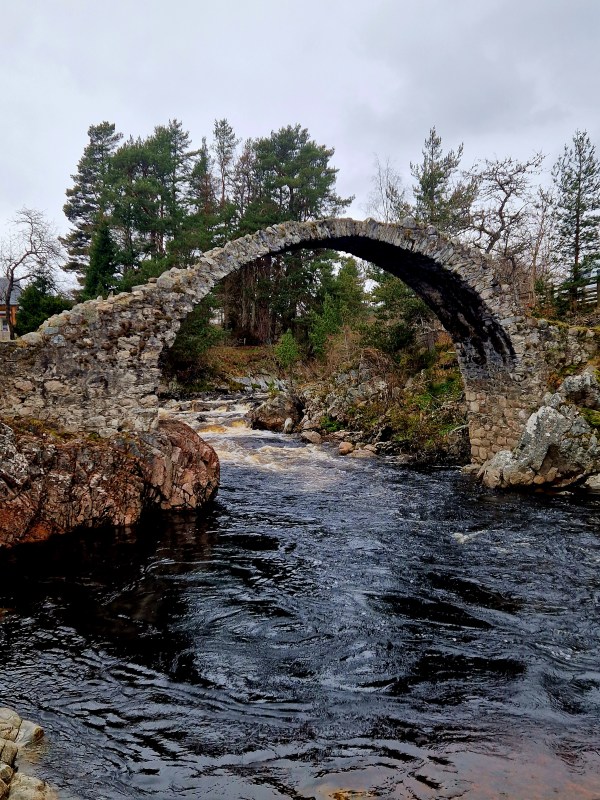
While passing through the Cairngorms we stopped to take a look at this iconic old bridge. Situated in the picturesque Highland village of Carrbridge and also known as ‘Coffin Bridge’, this bridge was built in 1717 to allow funeral processions to reach Duthil Church by crossing the River Dulnain. Notwithstanding, it was a welcome addition to the village, providing a way for tradesmen and locals to traverse the river. It’s a single span humpback arched bridge, now no longer in use and with its side rails missing, all that remains is a slender arch across the river. The viewpoint plaque reads:
“At the beginning of the eighteenth century, to the inconvenience of both travellers and local people, there was no point at which the River Dulnain could be crossed when it was in spate, and burials at the Church of Duthil were often delayed.
Brigadier-General Alexander Grant of Grant, Clan Chief, commissioned John Niccelsone, a mason from Ballindaloch, to build a bridge at Lynne of Dalrachney. Built between May and November 1717, the bridge was paid for out of stipends of the Parish of Duthill.
Its parapets and side walls were badly damaged in the 18th century and again in the famous flood of August 1829, giving the appearance it still has today. At the beginning of the eighteenth century, to the inconvenience of both travellers and local people, there was no point at which the River Dulnain could be crossed when it was in spate, and burials at the Church of Duthil were often delayed.
Brigadier-General Alexander Grant of Grant, Clan Chief, commissioned John Niccelsone, a mason from Ballindaloch, to build a bridge at Lynne of Dalrachney. Built between May and November 1717, the bridge was paid for out of stipends of the Parish of Duthill.
Its parapets and side walls were badly damaged in the 18th century and again in the famous flood of August 1829, giving the appearance it still has today.”
 Scottish Adventures - in a van