Driving through Elie in the East Neuk of Fife, I was attracted to the window display of a little pop-up clothing shop on the High Street. I stopped to take a peek inside. There, I joined in conversation with the friendly staff and a gaggle of other ladies who had also been tempted to browse. An hour later, I walked out with a pink gift bag on my arm containing several lovely items I hadn’t even known I needed!
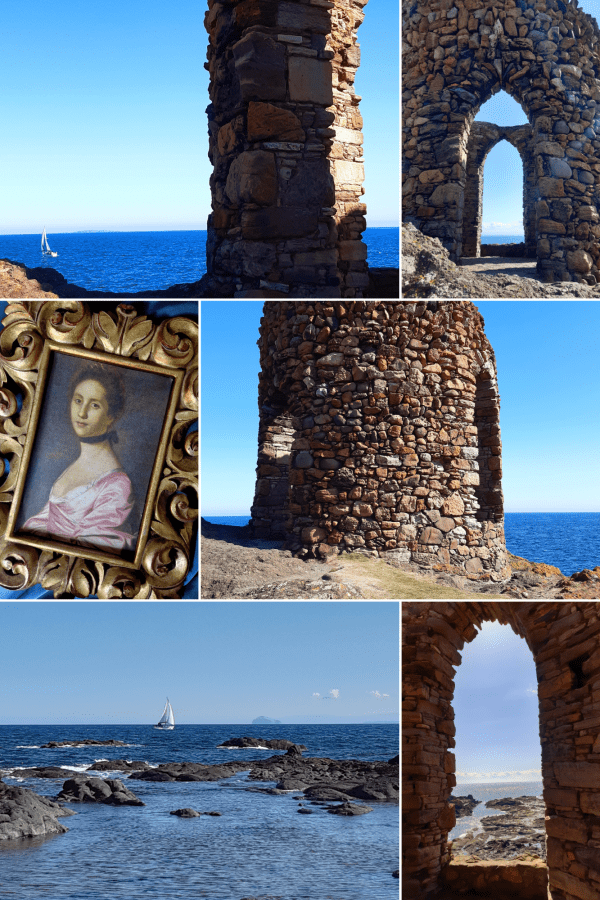
The purpose of my journey here, however, wasn’t to go shopping but to visit Lady’s Tower. The Tower sits on a rocky promontory at Ruby Bay, just outside Elie. Tiny garnets can be found in the reddish coloured sand here, hence the name, ‘Ruby Bay’. The tower itself is a red sandstone landmark which is set against the expanse of the Forth Estuary and like so many 18th century buildings it‘s now in ruin but, nevertheless, a very attractive and fascinating one to visit.
The tower comprises three massive arched window apertures which afford stunning views of the Forth. On the day I visited I could see as far as the Bass Rock and North Berwick Law. There had been two levels in the tower; a fireplace on the east wall of the ground floor with a staircase built against the west wall leading to an upper viewing platform.
Sir John Anstruther had the tower built in the 1770’s for the pleasure of his much doted upon wife, Lady Janet. Sir John was a Baronet, Scottish politician, local entrepreneur and industrialist who married Janet in 1750. She was the daughter of wealthy businessman and Scottish MP, Captain James Fall. It was alleged the Fall family were of gypsy heritage and much to her displeasure, Janet was nicknamed ‘Queen of the Gypsies’. She was a renowned beauty and most shockingly for the time, had a reputation amongst the men in their social circles for being an outrageous flirt! She was famously described by Thomas Carlisle, Scottish essayist, historian, and philosopher, as ‘a coquette and a beauty’.
Lady Anstruther loved sea-swimming and the health benefits she felt from it. As her habit was to swim naked, she insisted upon absolute privacy and so before bathing a servant would be sent into Elie, ringing a bell, to ensure locals stayed away. To enable Janet to dress discretely after her swim, her husband also had a vaulted changing room built down at shore level. The Tower was a place where she could relax and take in the views, watch the world go by and unwind from the exertions of her swim. There was, however, something which marred Janet’s overall pleasure of this wonderful setting and that was the tiny hamlet of Balclevie, a collection of dilapidated dwellings where some of the poorest people in the community lived.
Revealing her arrogant and cold-hearted nature, Janet felt Balclevie was offending to her eyes therefore had the entire village razed to improve her view. It is thought that, in truth, the tinker inhabitants of the hamlet reminded her too much of her own family origins. Flattening Balclevie did nothing, however, to abate the taunts about Janet’s gypsy background being made in the streets of Elie. She was determined to be recognised as a member of the landed gentry, her dress and deportment contrived to express her aristocratic rank. It’s said an old woman who had been evicted when her home at Balclevie was demolished upon Janet’s instructions, placed a curse on the family in retribution. Legend tells that the curse would see only six generations of the Anstruther family live in the grand ‘Elie House’. This foretelling did come to pass, when the cash-strapped sixth generation of Anstruther’s sold Elie House to the Baird family in 1853.
Lady Janet died in 1802, aged 77. I was able to ascertain that she is buried in the Elie Churchyard and although I spent time looking for the grave, I was unable to find it. It could be that hers was a burial slab, now overgrown with moss or perhaps, as the Anstruther family had commissioned the building of the church tower, she had been afforded an internment within the church itself. Finding her is a quest for another day.
 Scottish Adventures - in a van