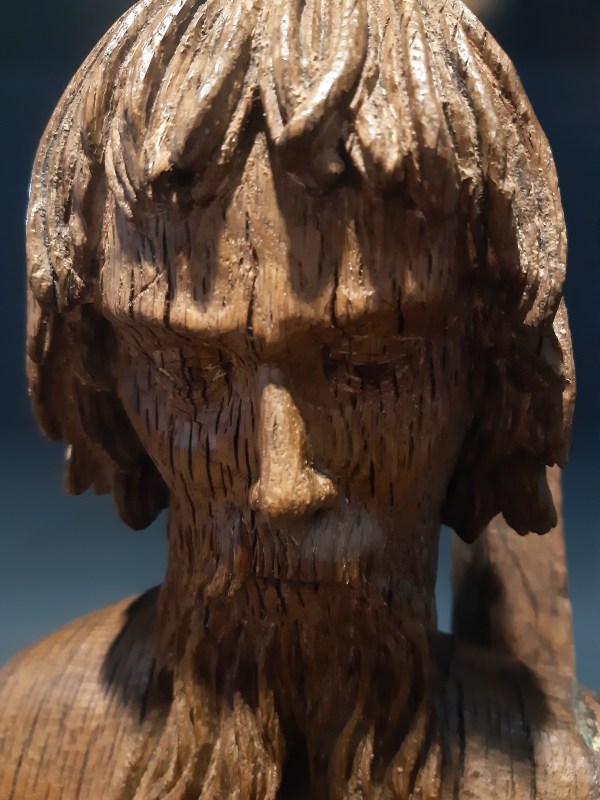
This oak carving of St Andrew is thought to have come to Scotland from a church in Northern Europe. Legend says that the bones of St Andrew, disciple of Jesus, were brought from Greece in the 350’s by Bishop Regulus. Objects associated with holy people were the focus of Christian devotion in medieval Europe hence the town (originally Kilrimund) became a major pilgrimage site and the centre of the cult of St Andrew. Pilgrims made long journeys to visit his relics and in the 1100’s, Queen Margaret of Scotland established a free ferry across the Firth of Forth to enable an easier journey north to St Andrews. When pilgrims arrived, the town’s street layout directed them to the Cathedral where the relics were richly housed.
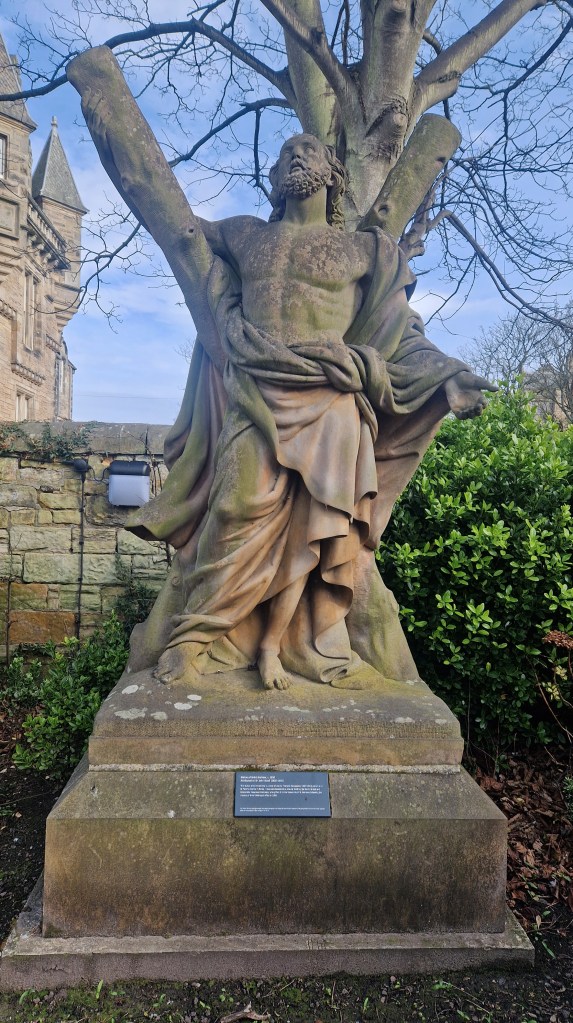
By around 1200, the town was named after St Andrew and in 1320 he was officially adopted as Scotland’s patron saint and explicitly mentioned in the Declaration of Arbroath. St Andrew’s symbol of the saltire, an X-shaped cross, became a national emblem and later was assumed as our National Flag.
The above Statue of St Andrew, which is in the grounds of Wardlaw Museum in St Andrews, is attributed to Sir John Steell (1804-1891) and is a copy of one sculpted by Francios Duquesnoy (1597-1643) which sits in St Peter’s Basilica in Rome.
 Scottish Adventures - in a van