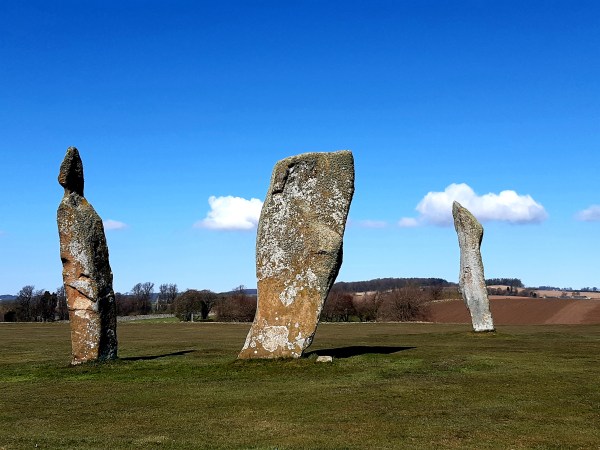
Where once where there were four, now there remains three very impressive, irregularly shaped, red sandstone megaliths. They are thought to have originally been part of the 16M circumference of a complete stone circle from the bronze age, 2000 – 1500BC. It’s said that the missing fourth stone had been broken by treasure hunters, the base remaining with the broken upper lying nearby until 1792. It was then moved by a farmer to allow for better ploughing of the field and was subsequently lost to memory.
A stone lined grave (cist) containing a skull was discovered near the Lundin stones in 1844. The skull, was given to Prof of Anatomy at Edinburgh University, Sir William Turner, who reported it had a metal arrowhead imbedded within a fracture but this crumbled to rust when it was touched. The discovery of the ‘ancient sepulchre’ draws parallels with other standing stone sites in Fife where human remains were also found.
Local folklore tells that the Lundin stones were memorials to Danish Chiefs who had been slain during a great battle here. However, these days the stones are witness to nothing more belligerent than golfing competitions as they present a magnificent feature on the second fairway of Lundin Links Ladies Golf Course.
The stone sitting south east, has a height of 4.2M with a slight northward incline. This one is heavily weathered, pitted with a large crack that has developed on its east side. The south stone is 4.6M in height and decidedly inclined southward. Lastly, the north stone is the tallest at 5.1M, having a slight incline westward. Bear in mind that in order for these stones to remain standing they will need be seated into the ground to equivalent lengths
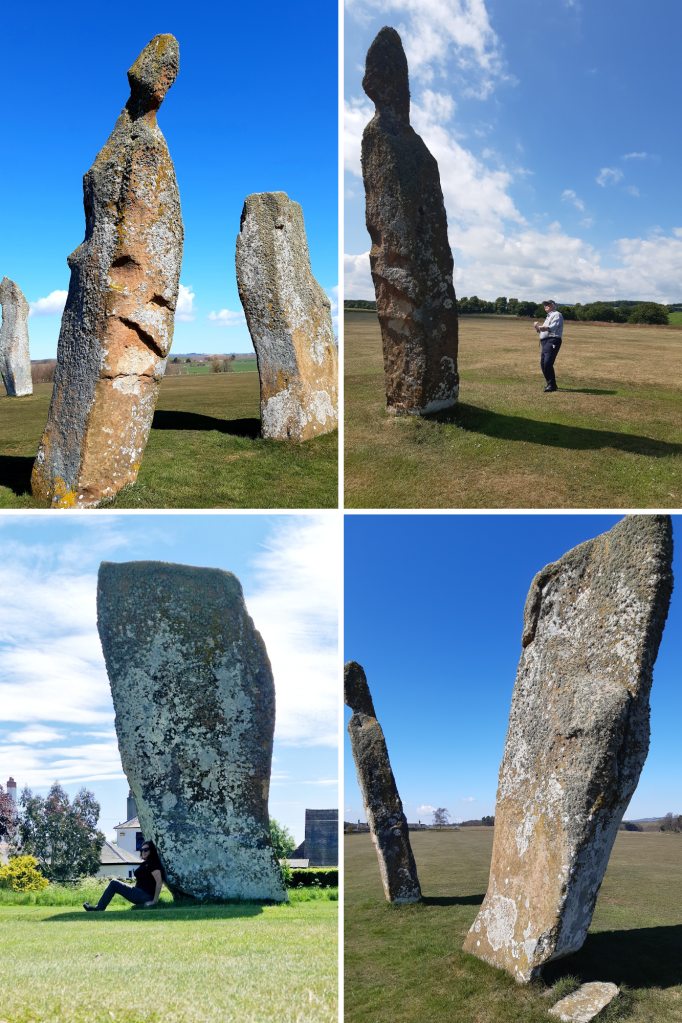
I’ve come here many times with family or friends who’ve had an interest in Scotland’s ancient history and they’ve all been impressed with the magnitude of the Lundin Stones and the fact that they still remain after all this time. If you decide to visit, please be polite by asking at the Club House if it’s safe to walk to the stones as there may be golfers about to tee off. Be sure to also skirt the course on your way to and from the site. A blow to the head with a golf ball could mean your skull might be the next to leave here with a fracture!

 Scottish Adventures - in a van