Standing Stones of Lundin, Lundin Links – Fife

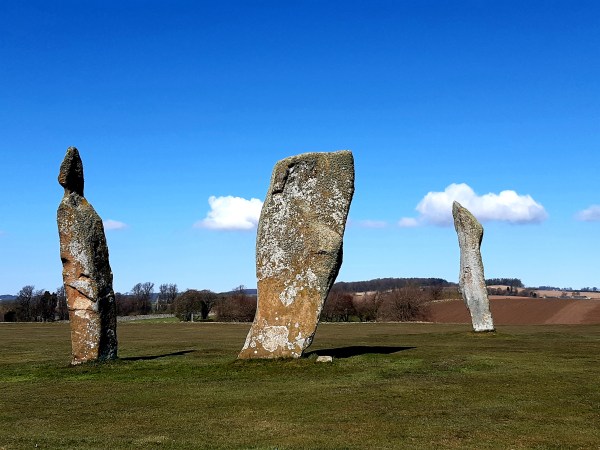
Where once where there were four, now there remains three very impressive, irregularly shaped, red sandstone megaliths. They are thought to have originally been part of the 16M circumference of a complete stone circle from the bronze age, 2000 – 1500BC. It’s said that the missing fourth stone had been broken by treasure hunters, the base remaining with the broken upper lying nearby until 1792. It was then moved by a farmer to allow for better ploughing of the field and was subsequently lost to memory.

A stone lined grave (cist) containing a skull was discovered near the Lundin stones in 1844. The skull, was given to Prof of Anatomy at Edinburgh University, Sir William Turner, who reported it had a metal arrowhead imbedded within a fracture but this crumbled to rust when it was touched. The discovery of the ‘ancient sepulchre’ draws parallels with other standing stone sites in Fife where human remains were also found. 

Local folklore tells that the Lundin stones were memorials to Danish Chiefs who had been slain during a great battle here. However, these days the stones are witness to nothing more belligerent than golfing competitions as they present a magnificent feature on the second fairway of Lundin Links Ladies Golf Course.

The stone sitting south east, has a height of 4.2M with a slight northward incline. This one is heavily weathered, pitted with a large crack that has developed on its east side. The south stone is 4.6M in height and decidedly inclined southward. Lastly, the north stone is the tallest at 5.1M, having a slight incline westward. Bear in mind that in order for these stones to remain standing they will need be seated into the ground to equivalent lengths
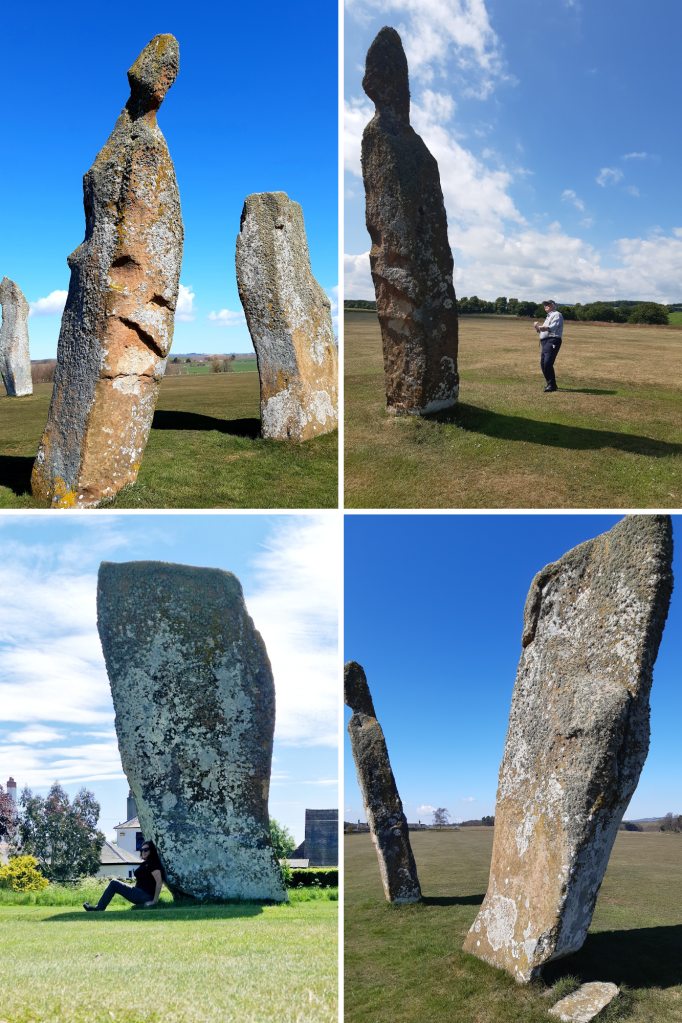
I’ve come here many times with family or friends who’ve had an interest in Scotland’s ancient history and they’ve all been impressed with the magnitude of the Lundin Stones and the fact that they still remain after all this time. If you decide to visit, please be polite by asking at the Club House if it’s safe to walk to the stones as there may be golfers about to tee off. Be sure to also skirt the course on your way to and from the site. A blow to the head with a golf ball could mean your skull might be the next to leave here with a fracture!
Lady’s Tower, Elie – Fife

Driving through Elie in the East Neuk of Fife, I was attracted to the window display of a little pop-up clothing shop on the High Street. I stopped to take a peek inside. There, I joined in conversation with the friendly staff and a gaggle of other ladies who had also been tempted to browse. An hour later, I walked out with a pink gift bag on my arm containing several lovely items I hadn’t even known I needed! 

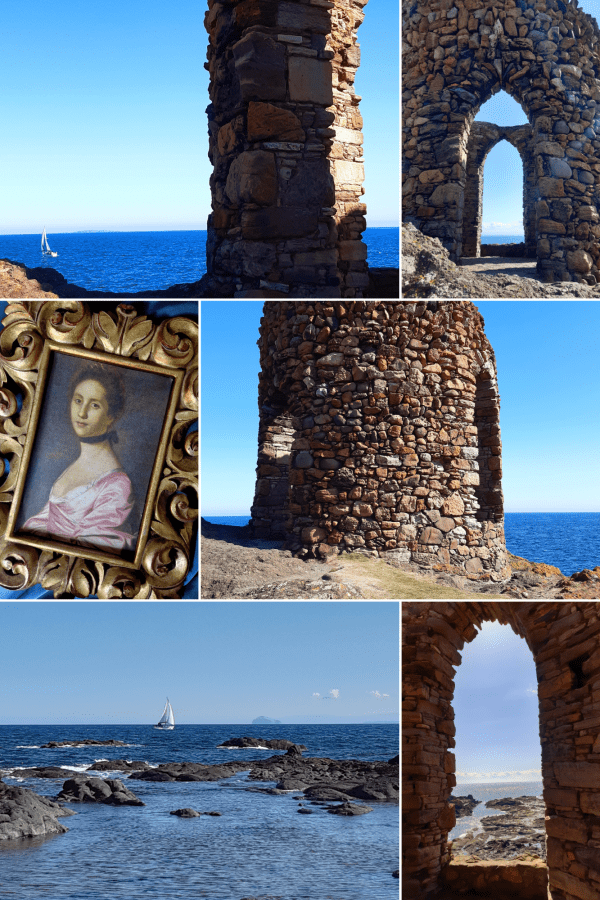
The purpose of my journey here, however, wasn’t to go shopping but to visit Lady’s Tower.  The Tower sits on a rocky promontory at Ruby Bay, just outside Elie.  Tiny garnets can be found in the reddish coloured sand here, hence the name, ‘Ruby Bay’. The tower itself is a red sandstone landmark which is set against the expanse of the Forth Estuary and like so many 18th century buildings it‘s now in ruin but, nevertheless, a very attractive and fascinating one to visit.

The tower comprises three massive arched window apertures which afford stunning views of the Forth. On the day I visited I could see as far as the Bass Rock and North Berwick Law. There had been two levels in the tower; a fireplace on the east wall of the ground floor with a staircase built against the west wall leading to an upper viewing platform.

Sir John Anstruther had the tower built in the 1770’s for the pleasure of his much doted upon wife, Lady Janet. Sir John was a Baronet, Scottish politician, local entrepreneur and industrialist who married Janet in 1750. She was the daughter of wealthy businessman and Scottish MP, Captain James Fall.  It was alleged the Fall family were of gypsy heritage and much to her displeasure, Janet was nicknamed ‘Queen of the Gypsies’.  She was a renowned beauty and most shockingly for the time, had a reputation amongst the men in their social circles for being an outrageous flirt! She was famously described by Thomas Carlisle, Scottish essayist, historian, and philosopher, as ‘a coquette and a beauty’.

Lady Anstruther loved sea-swimming and the health benefits she felt from it. As her habit was to swim naked, she insisted upon absolute privacy and so before bathing a servant would be sent into Elie, ringing a bell, to ensure locals stayed away. To enable Janet to dress discretely after her swim, her husband also had a vaulted changing room built down at shore level. The Tower was a place where she could relax and take in the views, watch the world go by and unwind from the exertions of her swim. There was, however, something which marred Janet’s overall pleasure of this wonderful setting and that was the tiny hamlet of Balclevie, a collection of dilapidated dwellings where some of the poorest people in the community lived.

Revealing her arrogant and cold-hearted nature, Janet felt Balclevie was offending to her eyes therefore had the entire village razed to improve her view. It is thought that, in truth, the tinker inhabitants of the hamlet reminded her too much of her own family origins. Flattening Balclevie did nothing, however, to abate the taunts about Janet’s gypsy background being made in the streets of Elie. She was determined to be recognised as a member of the landed gentry, her dress and deportment contrived to express her aristocratic rank. It’s said an old woman who had been evicted when her home at Balclevie was demolished upon Janet’s instructions, placed a curse on the family in retribution. Legend tells that the curse would see only six generations of the Anstruther family live in the grand ‘Elie House’. This foretelling did come to pass, when the cash-strapped sixth generation of Anstruther’s sold Elie House to the Baird family in 1853.

Lady Janet died in 1802, aged 77. I was able to ascertain that she is buried in the Elie Churchyard and although I spent time looking for the grave, I was unable to find it. It could be that hers was a burial slab, now overgrown with moss or perhaps, as the Anstruther family had commissioned the building of the church tower, she had been afforded an internment within the church itself.  Finding her is a quest for another day.

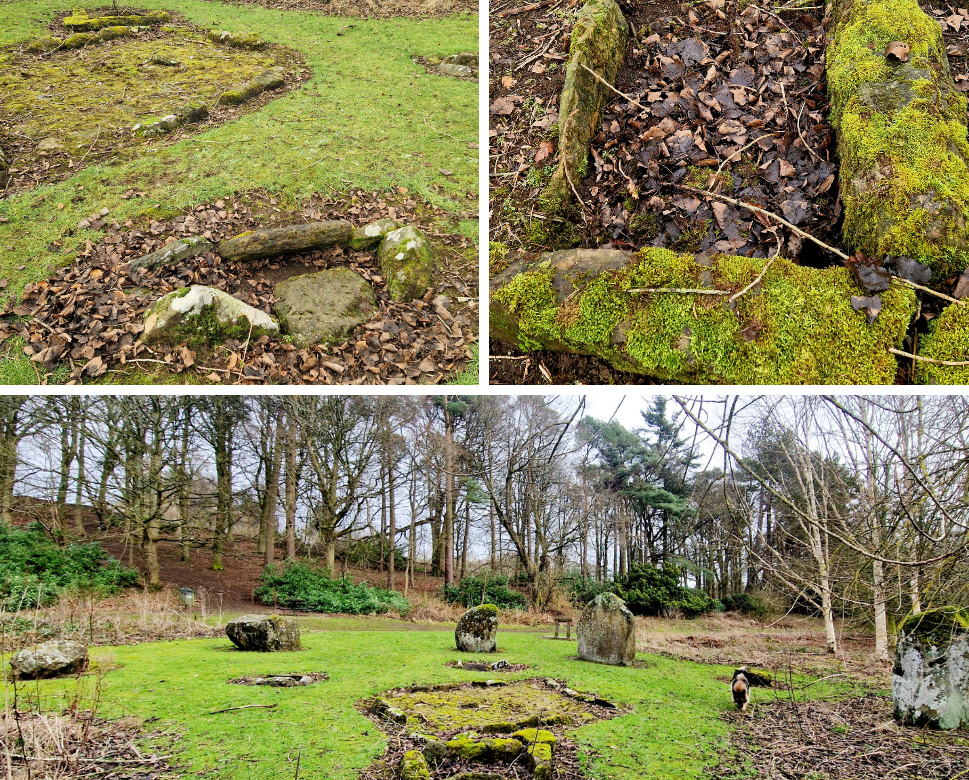
Balfarg Henge & Balbirnie Stone Circle, Fife

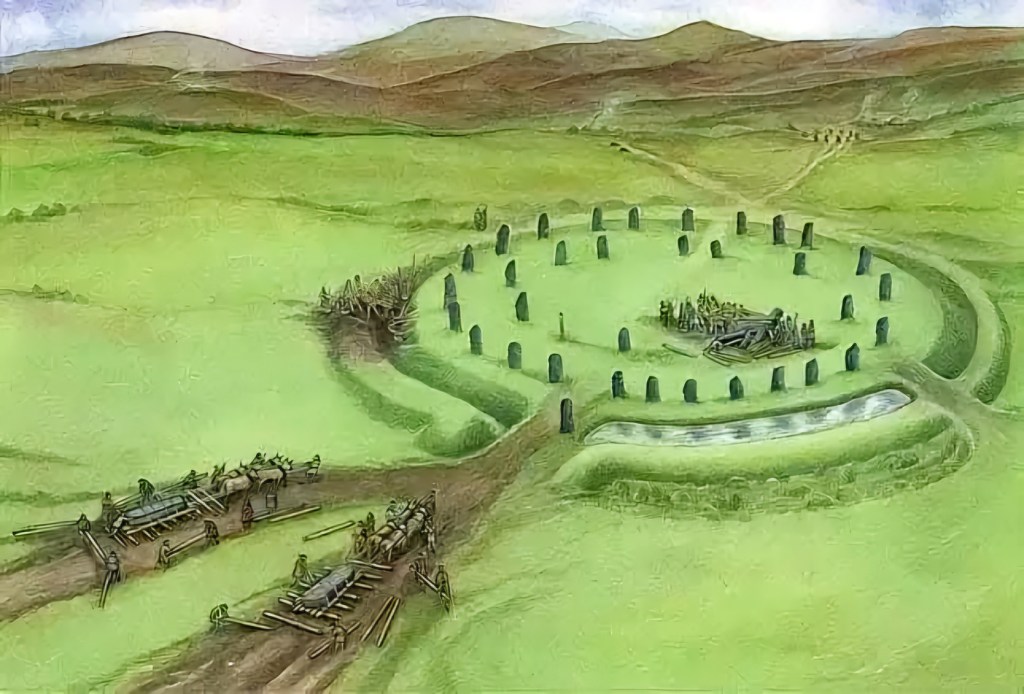
Located on the outskirts of Glenrothes in Fife, Balfarg Henge is now incongruously surrounded by a modern housing estate. Encircled by hills, this was once a revered landscape and main centre of ritual, sacred to generations of prehistoric people. While there are only two of its original stones remaining and sadly, a rather underwhelming place to visit these days than other Neolithic monuments in Scotland, (such as Calanais in Lewis or Ring of Brogdar in Orkney) 4,000 years ago Balfarg Henge would have been equally as evocative.  The ceremonial, circular enclosure, measuring 60 metres across (known as a ‘henge’), was formed by a bank with an internal ditch and encompassed temples for the living and graves for the dead.  Evidence of ritual feasting, sacrifice, smashed pottery and human burial were found here and at the centre of the henge, lying level with the grass, is a massive stone slab which covers a stone cist, containing the remains of a teenage boy from that period.

The nearby Balbirnie Stone Circle was excavated then moved when the current main road was widened.  It originally had been only 300 metres from Balfarg Henge, in a much more prominent position with the circle facing the midsummer sun rising over Clatto Hill.  It had a hearth at its centre, perhaps for lighting up night-time ceremonies. Communities would have gathered here to celebrate seasonal festivals and to honour their ancestors. Balbirnie became a place of burial where the cremated bones of women and children were placed in stone cists, along with precious objects.

Neolithic peoples cleared woodland and introduced agriculture to Fife around 6,000 years ago.  They were also hunter-gatherers, moving from place to place throughout the year as seasons changed. The efforts made by these people to build shared sacred sites like Balfarg and Balbirnie affirms that their society was sophisticated and organised.

Earl’s Palace, Birsay – Orkney

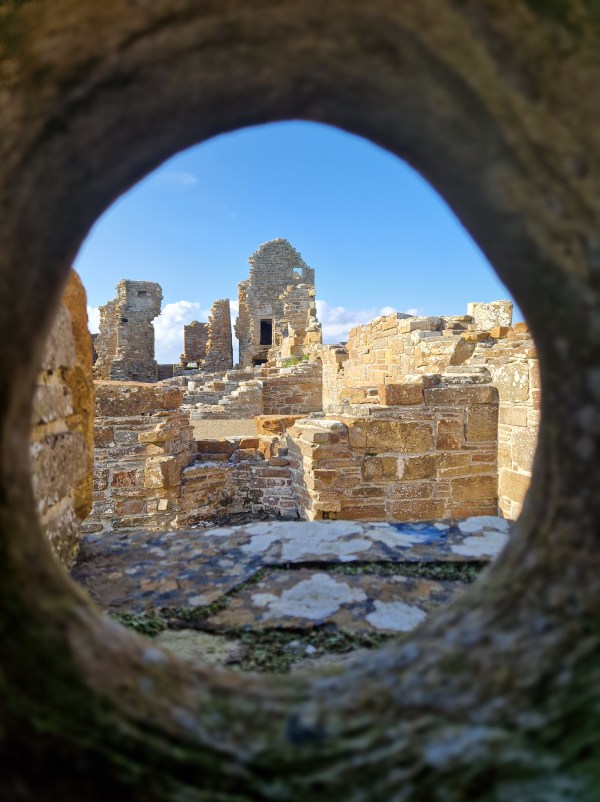
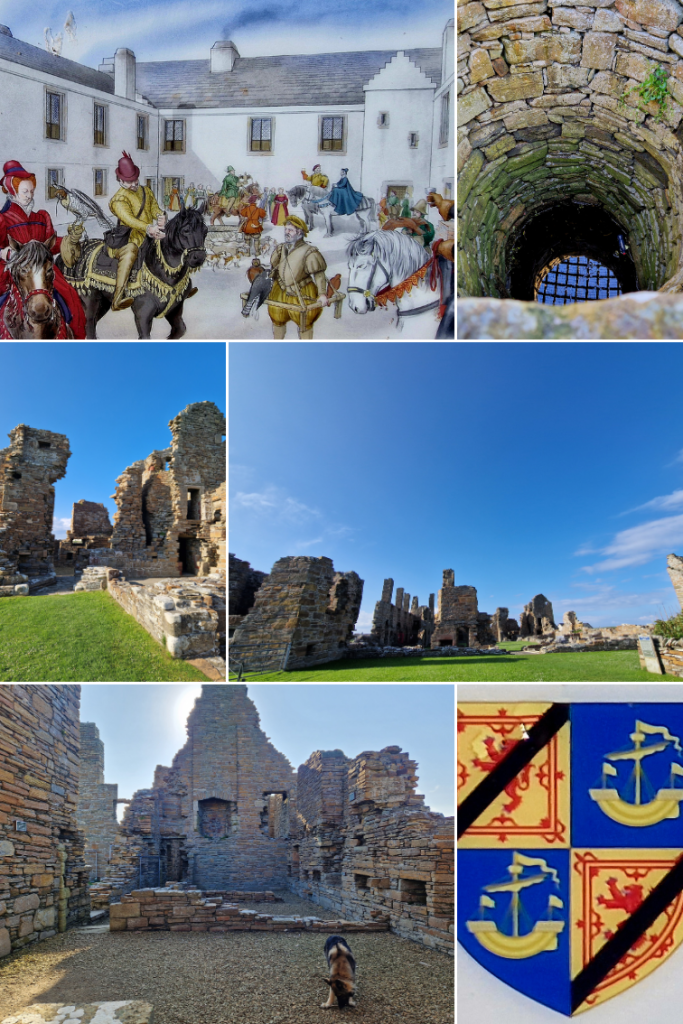
The Palace was built in the 1570’s – 1580’s for the notorious Earl Robert Steward, half brother of Mary Queen of Scots. Mary had 13 siblings and Robert was an illegitimate son of King James V and noblewoman Euphimia Elphinstone. After Mary’s forced abdication, Robert remained in the good graces of her son, the young James VI so that in 1581, he was elevated to Earl (Sheriff) of Orkney. Robert considered himself absolute ruler of Orkney and Shetland and this Renaissance style palace was a bold statement of his wealth and power. An inscription in Latin above the palace’s main entrance read – ‘Lord Robert Stewart, son of King James V, King of Scots, commissioned this building’. While Robert clung to his Royal connection, his coat of arms required the Scottish Royal Arms to bear a ribbon through the middle, a symbol of his illegitimacy, while the 2nd and 3rd quarters show the arms of the Earldom of Orkney.

Despite being a luxurious home, defence was still a major consideration. The palace was built around three sides of a courtyard with projecting towers at 3 of its 4 corners and a wall enclosing the north side. There were entrances to the south and west. To mitigate any security risk, only the upper floors had large windows while the ground floors had small openings and an array of gun loops from which artillerymen could cover every side of the building. Despite the many gun holes, the palace was still a place of grandeur and elegance. A single long gallery with views out to sea ran along the west wing and the building had fine panelling and painted ceilings in all the rooms that were needed to keep the Earl living in style. There were kitchens, a ‘girnel’ (granary), brewhouse and ample cellars for supplies. The palace was also equipped for sport and exercise, having archery butts, and a bowling green.

Earl Robert died in 1593 and his son Patrick succeeded him to also become Earl. Patrick was known as ‘Black Patie’ with a reputation for violence and a taste for luxury he couldn’t afford. In 1609 Patrick was imprisoned for ‘monyfauld wrongis’, including theft of lands and funds, oppression of local people, kidnapping, torture and murder. While incarcerated in Dumbarton, Patrick orchestrated a rising in Orkney however it failed and he was summarily beheaded for treason. By the time the Palace was taken over for use by Cromwell’s troops in 1653, most traces of Earl Robert’s extravagant lifestyle were gone and the kitchen contained ‘nothing, but mukk and filth!’ Thereafter the palace was used occasionally by later earls of Orkney but by 1700 it had fallen into decay.

It was such a beautiful, sunny day when we visited and although now in ruin, the palace still exudes an air of its previous magnificence. Definitely worth taking the time stop by.

The Fortingall Yew

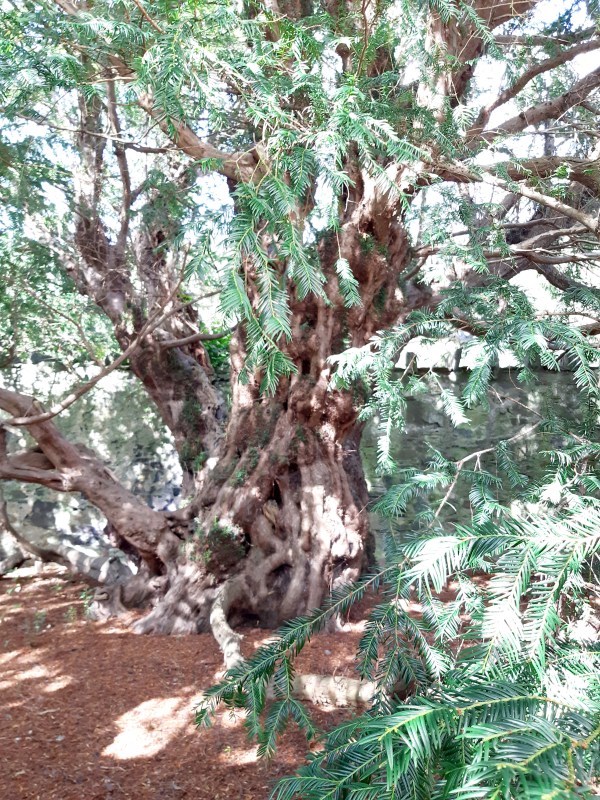
Just a short scenic drive from Loch Tay, in the hamlet of Fortingall, resides Europe’s (and possibly the World’s) oldest living thing. It’s estimated that the roots of this tree weave back over 5,000 years. Under a veil of coniferous needles you can see the relic trunks of what was once a huge, ancient Yew Tree. In 1769 the tree had a girth of approximately 56ft (17m) but sadly as a result of rapacious souvenir hunters, large sections of the yew were ‘appropriated’. Although sitting within the grounds of Fortingall churchyard, a new enclosure which it now occupies, had to be built to stop the tree from being completely destroyed.

Before the arrival of Christianity, the Yew was known as the tree of eternity. At around 500 years old, when most trees have died, Yews start to grow again. This otherworldly power led early people to revere the Yew and the Fortingall Yew Tree may have marked a place of worship for them. Archaeological evidence indicates this area has been inhabited for more than 5,000 years and three groups of standing stones and numerous large, cupmarked stones from that timeline can be found nearby. As with many ‘pagan’ sites, when early Christians arrived at Fortingall in the 7th century, they built their new church next to the Yew.

Over subsequent centuries, Yew trees continued to be cultivated within the enclosed grounds of Churches throughout Britain because although the Yew is toxic to livestock, the wood from these trees was best for producing longbows.

Mermaid of the North

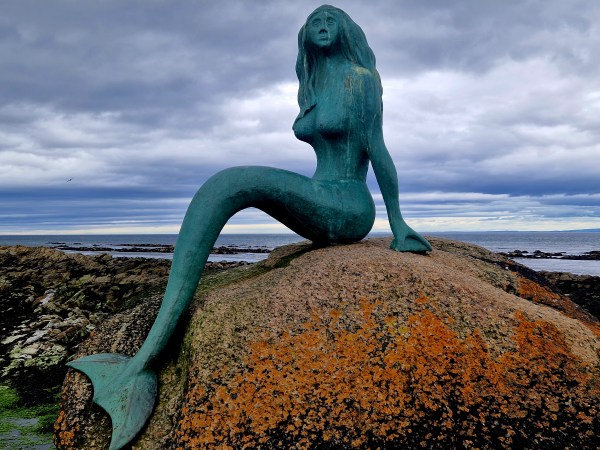
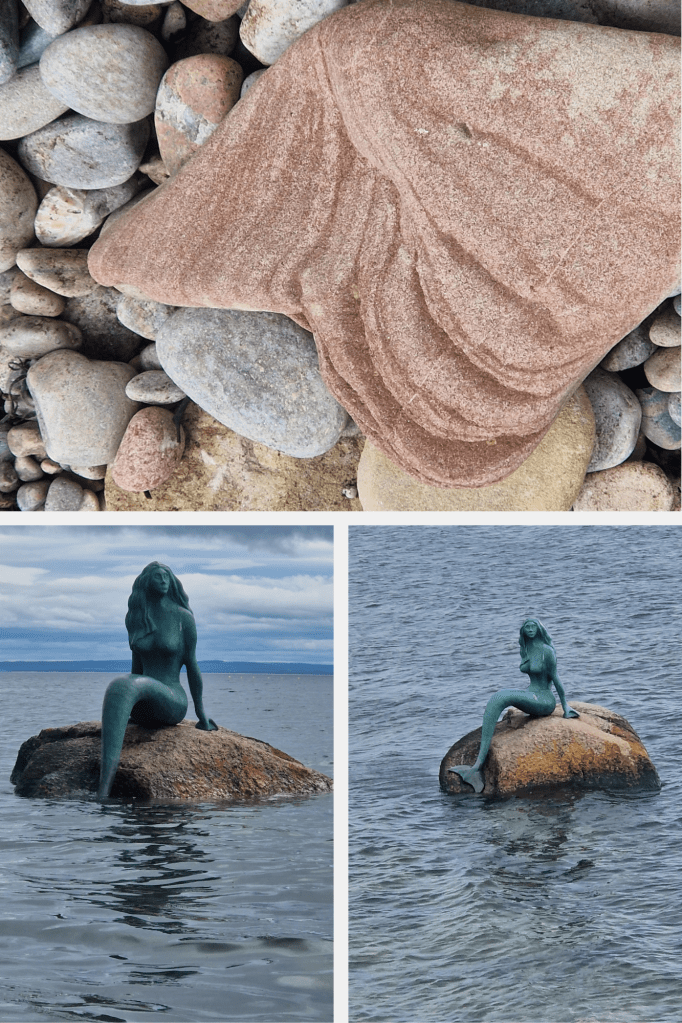
Capturing the imaginations of those who visit her, the alluring Mermaid of the North perches on ‘Clach Dubh’ (Black Rock) by the village of Balintore, Easter Ross. Coastal fables tell of a Mermaid who was captured by a cunning fisherman who hid her tail. Years later, after bearing his children, she found her tail and escaped back to sea, returning regularly to the shore, bringing fish for her hungry family.

Donal had left his boat to gather gulls’ eggs, up high on the cliff, when he noticed a beautiful, long haired woman sitting, singing on a rock below. He crept down for a closer look and upon realising she was a mermaid, grasped hold of her left hand, which it was said was the way to capture a mermaid as all of her strength is in her right hand. She begged him to let her go but being a lonely bachelor, he hid her tail so she couldn’t return to the sea and resolved to make her his wife. The Mermaid gradually settled into life with Donal, had several children with him and made a life for herself, caring for her family. One day though, while she was clearing away some dusty old things in the loft, she came upon her tail. She held it close and hurriedly ran back to the sea lest anyone stop her. Donal would often row out to sea, calling her, begging her to come home but she never returned to him. Everyday, however, her children would visit the shore where she would bring them fish to take home.

Millie & I always stop by, sometimes bringing friends, to visit The Mermaid of the North on our trips around the North Coast. She sits on her rock against the dramatic backdrop of the Moray Firth, where there are superb views of the coastline.

Queen’s Well, Glen Esk

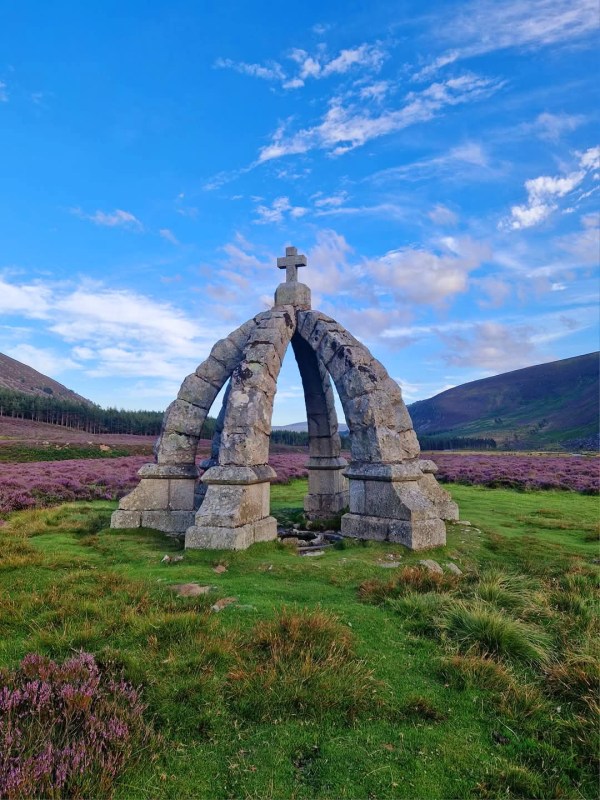
A 4mile (6.4Km) roundtrip ‘stroll’ will take you from Invermark to the magnificent ‘Queen’s Well’ in Glen Esk. The route is strewn with boulders so presents a bit of a challenge in places, however, certainly worth the effort as the scenery is spectacular, especially when the heather is in full bloom.

This granite crown shaped monument sits over a natural spring originally known as the ‘White Well’. The stone well was erected by Lord Dalhousie in 1861 to commemorate a visit made there by Queen Victoria and Prince Albert earlier that year. During their annual sojourn at Balmoral, the Royal couple and their entourage rode the 15mile (24Km) trip on ponies from Bridge of Muik, stopping for a picnic along the way. They met with Lord Dalhousie at the White Well where they refreshed themselves with the spring water before heading off to spend the night at his home, Invermark Lodge.

The inscription at the monument reads – ‘Her Majesty, Queen Victoria, and his Royal Highness the Prince Consort, visited this well and drank of its refreshing waters, on the 20th September, 1861, the year of Her Majesty’s great sorrow.’

Albert died on 14th December 1861, aged 42 years, having been diagnosed with typhoid fever.

Blog at WordPress.com.

Up ↑