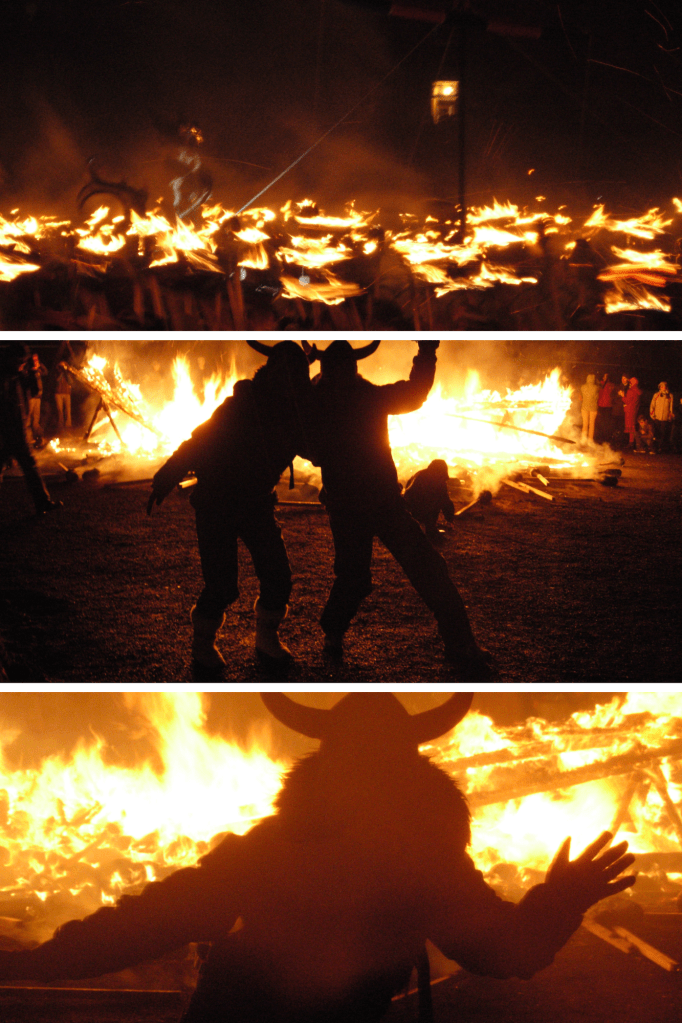
Up Helly Aa, Lerwick – Shetland

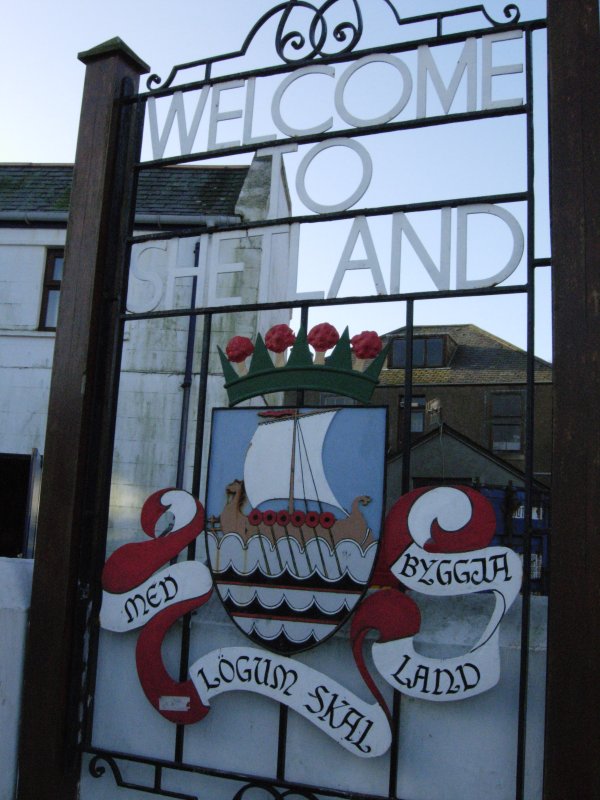
Shetland and Orkney had been domain of the Vikings from around 850 AD. In 1469 however, Princess Margaret, the 13 year old daughter of King Christian I of Denmark & Norway, was betrothed to King James III of Scotland. Her dowry was set at 6000 Guilders yet King Christian could only come up with 2000 Guilders therefore Shetland & Orkney were offered as security for the rest. The outstanding amount was never realised, so, on 20th February 1472 via an act of Parliament, both Orkney and Shetland officially became part of Scotland. Gradually Scottish culture spread throughout the islands but Norse customs and the Old Norse language have remained routed in the identity of the islanders over these many centuries. While Norse words and names are still evident the most discernible characteristic of Viking heritage are the Up Helly Aa events held throughout the Shetland archipelago from January to March every year.

The Up Helly Aa tradition began in the mid 19th century and gradually evolved into the annual festival we witness today, with many aspects still echoing the Viking celebrations of 150 years ago. Islanders are very much involved in the event and need to have been resident in Shetland for at least five years before they can even participate in a squad and the procession. To be Guizer Jarl, a member must have served at least 16 years on the committee.

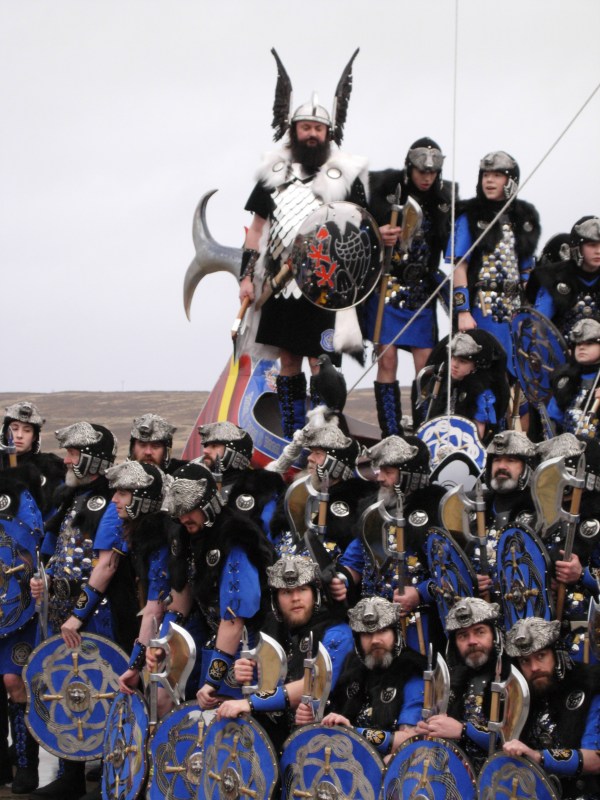
The building of the Viking Galley, making Viking costumes and the thousands of torches are done by volunteers and the Jarl Squad, working tirelessly throughout the winter until everything is ready. The reveal of the Galley and the Jarl Squad is kept a secret until the big day when they step out for the first time to start the Up Helly Aa morning parades.
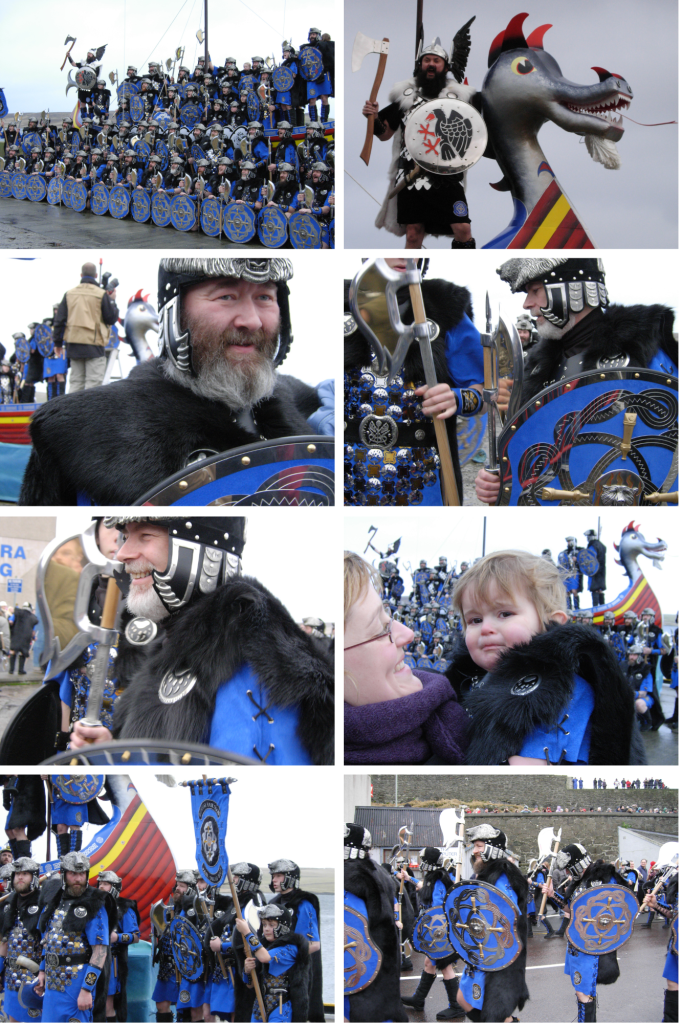
The evening procession incorporates 46 additional squads dressed in a variety of themes with performances choreographed in preparation for the after event parties. When darkness has descended, the squads assemble at 7pm to the sound of a Pipe Band after which the Guizer Jarl and his squad are ushered forward to the head of the parade with their Viking Longboat in tow, accompanied by the local Brass Band. All other squads then follow, marching behind them and through the town until finally reaching the Playing Field, circling the perimeter before heading to the Burning Site where the magnificent replica longboat is torched. This burning of the Galley signifies the end of the Yule period, in legendary Viking style, of course!
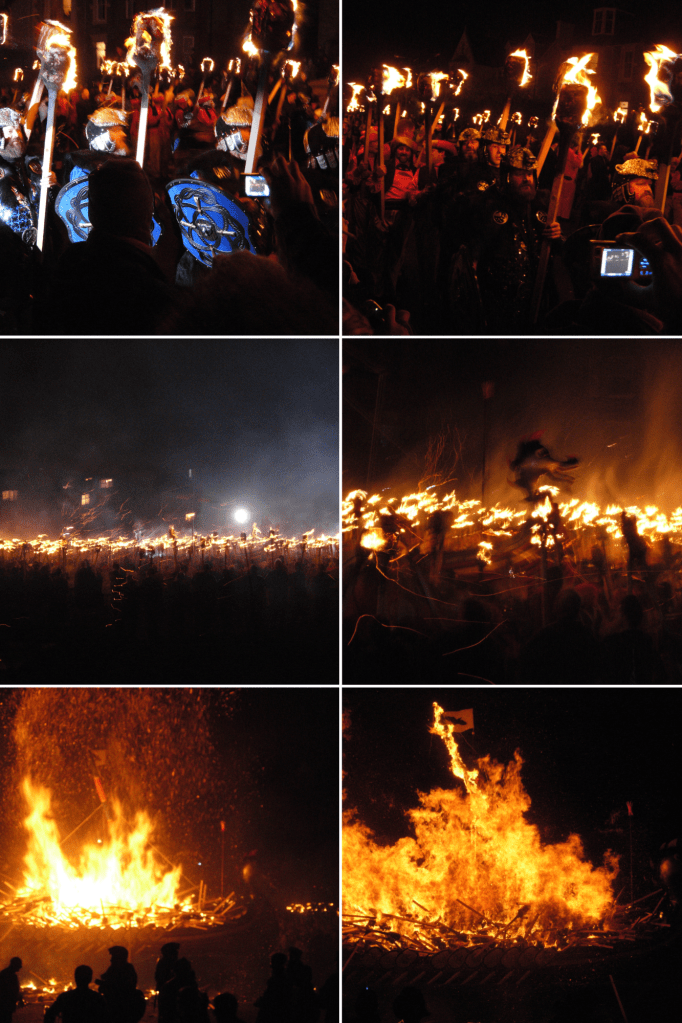
The festivities then move to many community halls where locals and visitors party through the night, dancing to Scottish Country Music and lapping up the entertainment provided by the guizer squads.

This celebration of Shetland’s Viking heritage is a festival unlike any other in the World. It truly is a community event with Lerwegians exuding immense pride in their uniquely special day and we found everyone to be incredibly welcoming and friendly. If you have a list of adventures you’d like to fulfil, I can highly recommend Up Helly Aa is on it!
Flying Trip to Lerwick for Up Helly Aa – Shetland

When your long-time buddy is a modern day Viking and you have some Viking blood flowing through your own veins, the best way to blow away the winter blues, of course, is by attending an ancient Viking festival. I’d listened to stories of Up Helly Aa as I was growing up and was excited to finally be going to this legendary event. Anne Lise arrived in Aberdeen from Oslo and we flew together, onward to Lerwick in Shetland, on an outstandingly beautiful day for a bucket list adventure.

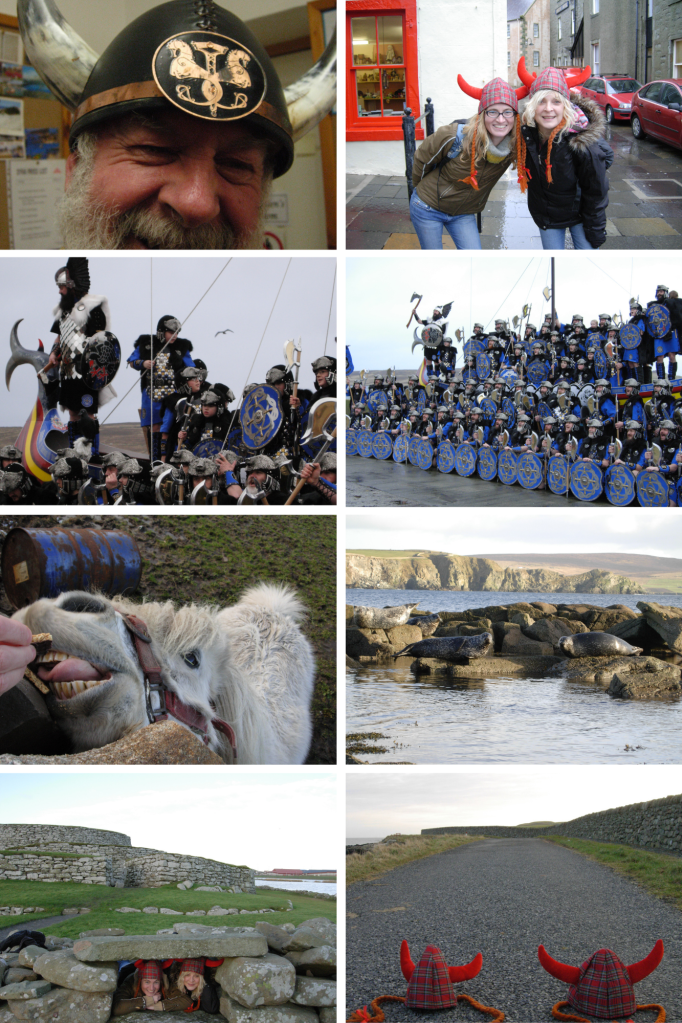
We’d booked into Lerwick hostel and on arrival, were greeted enthusiastically by the Manager, who showed us to our communal accommodation. He was a mine of information, providing us with details of where we needed to be and when, to make the most of our experience. He also, very kindly, insisted on driving us into town where we could find a bite to eat. Within moments of having ordered some food and sitting at our table we were surrounded by curious locals, enquiring who we were, where we were from and inviting us to a week of celebratory Up Helly Aa parties. They probably were fascinated with our mad hats! Next stop, a crowded bar that was full to bursting with good-humoured, Shetlanders, drinking and taking turns in the band that played traditional Shetland music into the early hours. Our trip couldn’t have gotten off to a more enjoyable start. What absolutely lovely folk! Back at the hostel that night, we bunked up along side fellow festival goers, two of whom were somewhat more ‘mature’ ladies. The pair seemed to have boundless energy, had been out walking all day, gone out for dinner, enjoyed the local music scene and were last to bed…and not very quiet about it either.

Up Helly Aa day and by 9.30am we were at Alexander Warf, waiting to see the Guizer Jarl and his Squad march into position for an iconic photo opportunity with their hard-wrought, beautifully crafted galley. And what a handsome band of Vikings they were. The mood was jovial and everyone was filled with elation for the day ahead. When eventually the Squad marched off to attend their community events, Anne Lise and I wandered along the Esplanade to the Market Cross then into town to browse around Lerwick’s old, narrow streets and quaint little shops. With plenty of time to spare, we also decided on exploration of the shore area, seal watching and making a fuss over loveable Shetland ponies, all the way out to Clickmin Broch (a bronze age settlement dating back to circa 400BC). The weather was wild and windy, exhilarating as we walked, filling us with anticipation for the upcoming festival to celebrate the end of Yuletide in this Viking world.

Darkness fell, the wind howled and the rain lashed but regardless, by 7pm the streets surrounding King Harald Playpark were lined with throngs of locals and visitors alike, waiting in suspense for the torchlit procession to begin. A strong smell of paraffin from hundreds of flaming torches filled the air as Guizers from 46 other squads mustered into place. The Jarl Squad was ushered through the ranks, towing the Galley with the Guizer Jarl standing magnificently at the prow while a brass band blared renditions of the ‘Up Helly Aa Song’, the ‘Galley Song’ and ‘The Norseman’s Home’. The spectacle of hundreds of Guizers with their flaring torches parading the around the streets, all singing proudly, was an unforgettable sight. Eventually, the Galley was lead into the Playground to its final repose, the Guizers spiralled around until an ultimate rendition of ‘The Norseman’s Home’, when Guizer Jarl stepped down at the very last moment and was first to hurl his torch into the longboat. With complex manoeuvring, hundreds of torches arched their way into the Galley, both an achingly sad yet breath-taking moment in this fiery comital and dispatch to Valhall. The heat was intense no matter where we were standing, everyone waiting with baited breath for the mast and then the dragon figure-head to collapse into the inferno.

With the ceremony at an end, the crowds gradually dispersed to ready themselves for whichever of the Up Helly Aa parties they were attending while the members of each squad made final preparations for their performances for the evenings attendees. Anne Lise and I had pre-arranged tickets for a ceilidh at the community centre so were thrilled to spend the rest of this incredible day being entertained by the squads and asked to dance by affable Shetlanders, into the wee small hours….

Lady’s Tower, Elie – Fife

Driving through Elie in the East Neuk of Fife, I was attracted to the window display of a little pop-up clothing shop on the High Street. I stopped to take a peek inside. There, I joined in conversation with the friendly staff and a gaggle of other ladies who had also been tempted to browse. An hour later, I walked out with a pink gift bag on my arm containing several lovely items I hadn’t even known I needed! 

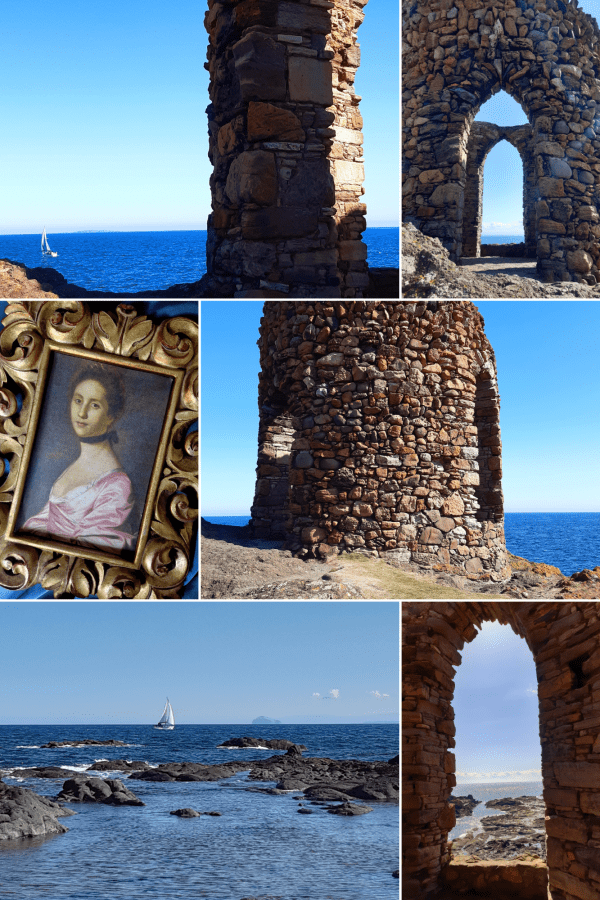
The purpose of my journey here, however, wasn’t to go shopping but to visit Lady’s Tower.  The Tower sits on a rocky promontory at Ruby Bay, just outside Elie.  Tiny garnets can be found in the reddish coloured sand here, hence the name, ‘Ruby Bay’. The tower itself is a red sandstone landmark which is set against the expanse of the Forth Estuary and like so many 18th century buildings it‘s now in ruin but, nevertheless, a very attractive and fascinating one to visit.

The tower comprises three massive arched window apertures which afford stunning views of the Forth. On the day I visited I could see as far as the Bass Rock and North Berwick Law. There had been two levels in the tower; a fireplace on the east wall of the ground floor with a staircase built against the west wall leading to an upper viewing platform.

Sir John Anstruther had the tower built in the 1770’s for the pleasure of his much doted upon wife, Lady Janet. Sir John was a Baronet, Scottish politician, local entrepreneur and industrialist who married Janet in 1750. She was the daughter of wealthy businessman and Scottish MP, Captain James Fall.  It was alleged the Fall family were of gypsy heritage and much to her displeasure, Janet was nicknamed ‘Queen of the Gypsies’.  She was a renowned beauty and most shockingly for the time, had a reputation amongst the men in their social circles for being an outrageous flirt! She was famously described by Thomas Carlisle, Scottish essayist, historian, and philosopher, as ‘a coquette and a beauty’.

Lady Anstruther loved sea-swimming and the health benefits she felt from it. As her habit was to swim naked, she insisted upon absolute privacy and so before bathing a servant would be sent into Elie, ringing a bell, to ensure locals stayed away. To enable Janet to dress discretely after her swim, her husband also had a vaulted changing room built down at shore level. The Tower was a place where she could relax and take in the views, watch the world go by and unwind from the exertions of her swim. There was, however, something which marred Janet’s overall pleasure of this wonderful setting and that was the tiny hamlet of Balclevie, a collection of dilapidated dwellings where some of the poorest people in the community lived.

Revealing her arrogant and cold-hearted nature, Janet felt Balclevie was offending to her eyes therefore had the entire village razed to improve her view. It is thought that, in truth, the tinker inhabitants of the hamlet reminded her too much of her own family origins. Flattening Balclevie did nothing, however, to abate the taunts about Janet’s gypsy background being made in the streets of Elie. She was determined to be recognised as a member of the landed gentry, her dress and deportment contrived to express her aristocratic rank. It’s said an old woman who had been evicted when her home at Balclevie was demolished upon Janet’s instructions, placed a curse on the family in retribution. Legend tells that the curse would see only six generations of the Anstruther family live in the grand ‘Elie House’. This foretelling did come to pass, when the cash-strapped sixth generation of Anstruther’s sold Elie House to the Baird family in 1853.

Lady Janet died in 1802, aged 77. I was able to ascertain that she is buried in the Elie Churchyard and although I spent time looking for the grave, I was unable to find it. It could be that hers was a burial slab, now overgrown with moss or perhaps, as the Anstruther family had commissioned the building of the church tower, she had been afforded an internment within the church itself.  Finding her is a quest for another day.

Blog at WordPress.com.

Up ↑