I was excited to come here on this wet and incredibly windy day to encounter a trio of remarkable remnants from our ancient past. AND what a way to begin my journey into Scotland’s pre-history! The Picts ruled much of Scotland during the Dark Ages, had a strong and distinct culture yet little is known of these warring and artistic people. Along the roadside in the village of Aberlermno are three magnificent Pictish stones bearing symbols from three graphic styles as their society evolved from Pagan to Christian worship.
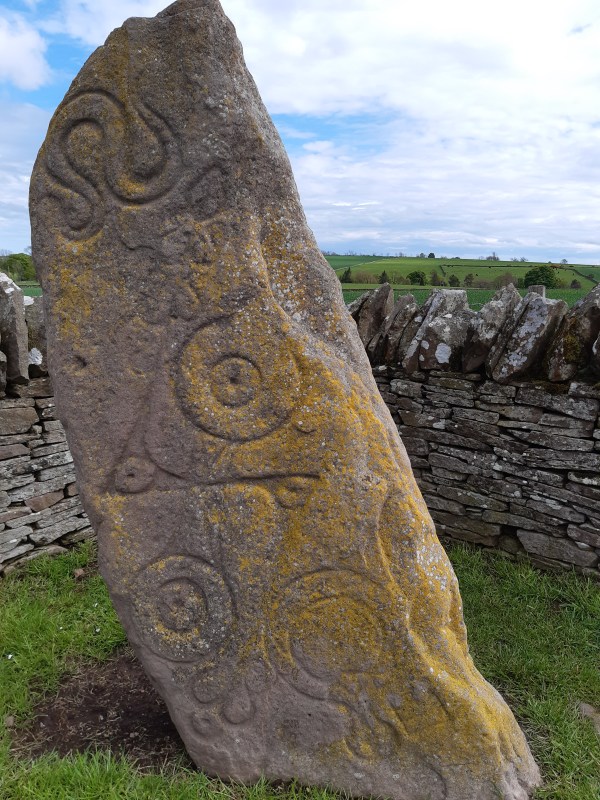
The Serpent Stone – cup marks on the left side of this stone suggest that it was most probably a neolithic standing stone, reused by the Picts. This is a Class I stone, standing nearly 2m tall with carvings deeply incised and still clearly visible.
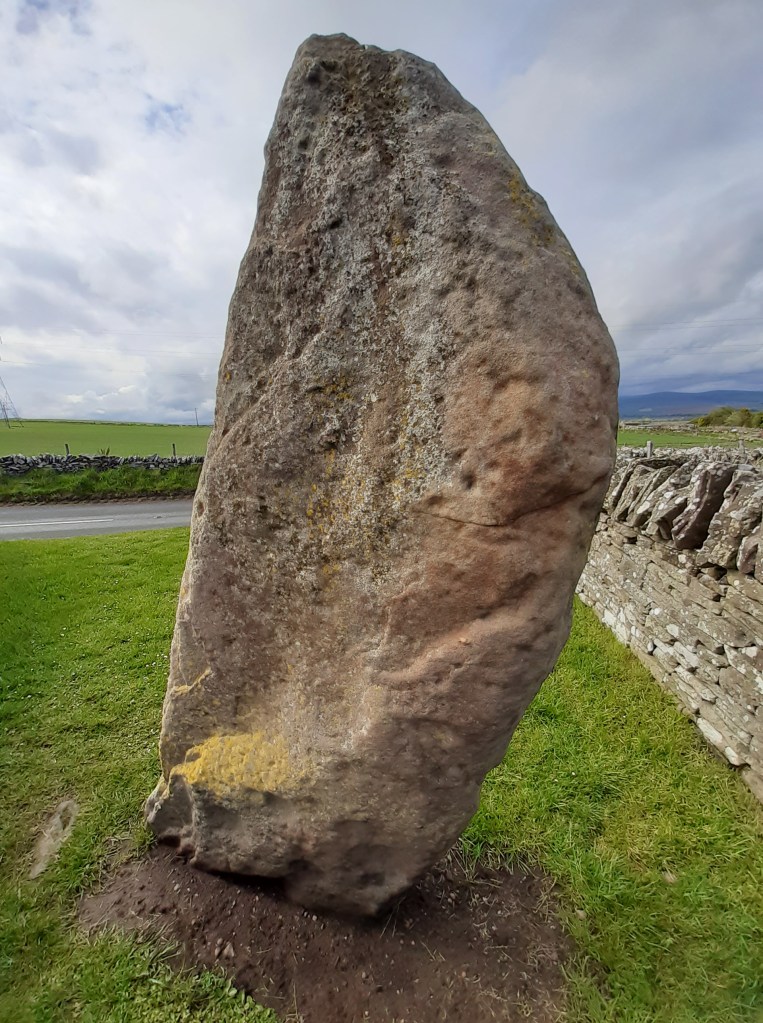
Class I stones – are natural rocks or boulders bearing incised Pictish symbols dating from the early bronze age. They bear no Christian images therefore likely carved before the arrival of St Columba and adoption of Christianity into Pictish culture.
This stone’s markings show a serpent above a double-disc and z-rod then a mirror and comb.
Serpent – throughout the World snakes have been associated with magic, death and rebirth, sex and healing.
Double Disk – perhaps represents two worlds: the here-and-now and the otherworld, life and death. Its has also been suggested that it signifies the marriage of two families. Z-Rod – this could represent someone whose spear was broken – dead – or who was a breaker of spears – a great warrior
Mirror & Comb – although on some stones the mirror is shown alone it is frequently thought to represent a woman. In the ancient world it has been used elsewhere as a symbol of the mother Goddess. Mirrors and combs also have magical connotations, appearing in folklore as enchanted objects
Whatever the meaning behind the symbols on this wonderful stone, they had a clear significance for the people who made them. The incisions are carbon dated at around 1500 years ago, elements of a lost hieroglyphical system used by the Picts for up to four centuries. They could represent a person of status within their community, mark a tribal location or make known tribal allegiance.
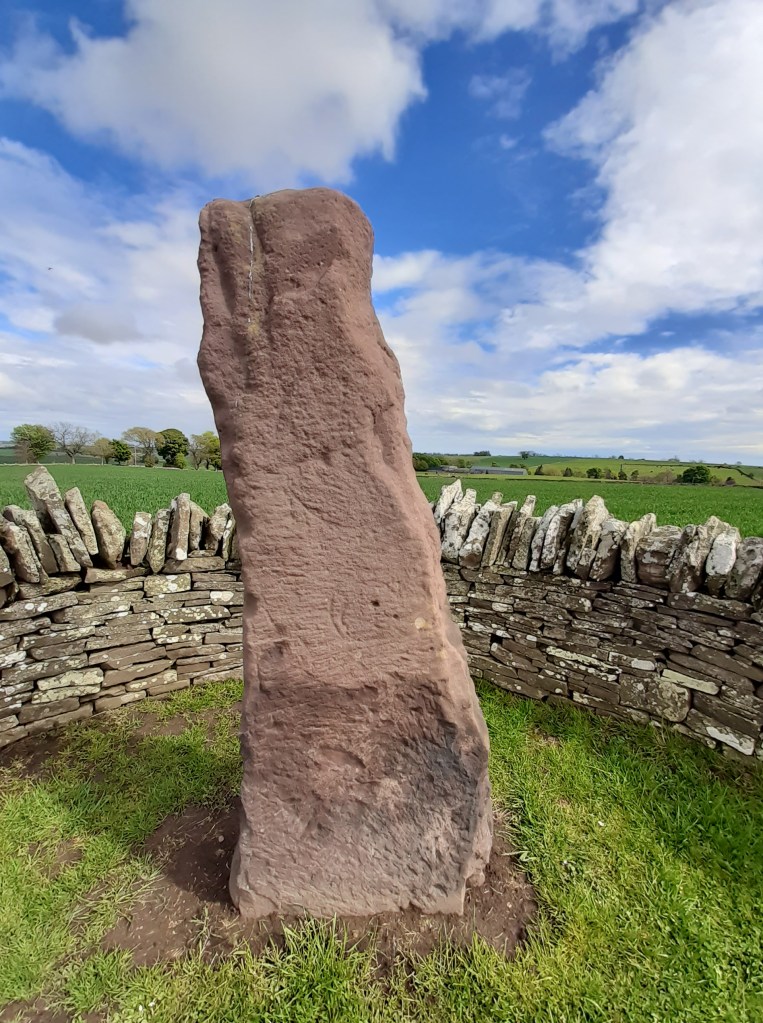
The Crescent Stone – only faint traces of a crescent marking and mirror remain on this Picitsh standing stone but nevertheless it still stands impressively alongside its neighbouring monoliths.
Crescent – having lunar associations, this could also represent the firmament. Often crossed with a v-rod (broken arrow), it’s one of the most common Pictish symbols.
Over these many centuries, such ancient monuments have eroded so that their stories are now completely lost to the wind and rain.
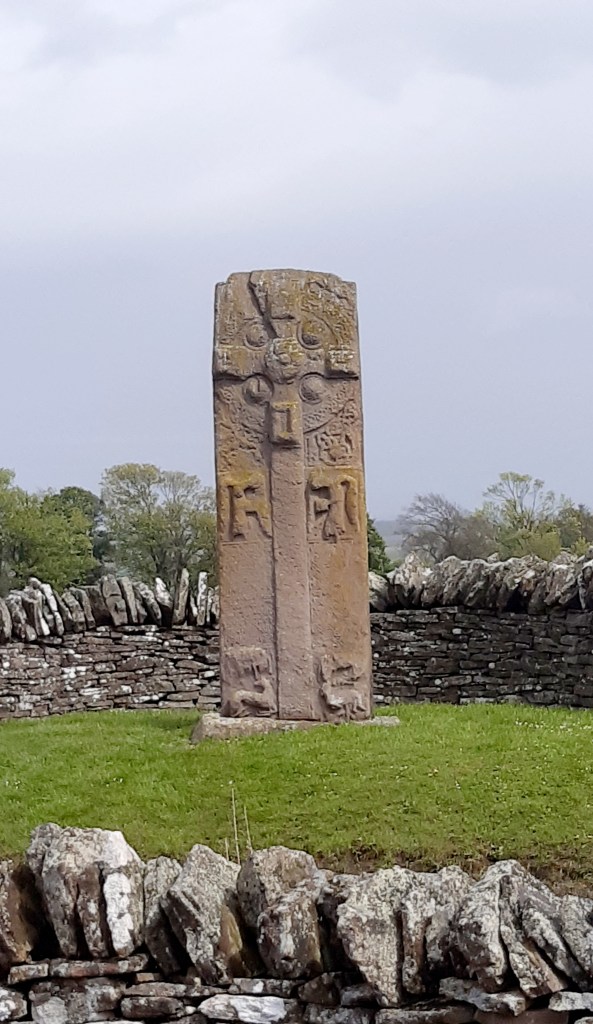
The Roadside Cross – standing in its original socket for over 1200 years, this stone is a Class II stone and testament to flourishing Christianity which had turned the Picts away from their Pagan religion within a mere 200 years of introduction. This impressive cross-slab was a declaration to the Glory of God.
Class II stones – these are shaped stones, carved in relief and almost always cross-slabs with Christian imagery and some traditional Pictish symbols.
The front of this stone has been deciphered as follows: Within a massive wheelhead cross there are Five circular bosses on the cross – possibly representing the wounds of Christ. Mourning Angels – holding gospel books.

The rear side: the top displays a Pictish symbol, the V-Rod – possibly the rising and setting of the sun/moon, then, below it there’s a Double Disk and Z-Rod – more elabourate than on the Serpent stone. A ceremonial hunt – with trumpeters below prominent Pictish symbols. David saving his flock from a lion – perhaps representing Christ the saviour. A centaur gathering medicinal plants – representing Christ the healer
These stones truly are incredible and although sitting by the roadside, each has been situated sympathetically in a small walled area to allow them to be viewed up-close. Grab your raincoat and go…!
 Scottish Adventures - in a van