Dunfallandy Stone – Pitlochry, Perthshire

I’d heard about this magnificent stone so finally took the time to stop off to search for it while heading to the Cairngorms. Once you get into Pitlochry it’s actually quite well signposted however there isn’t really much parking nearby so I left the van in town and Millie and I enjoyed a stroll (for the most part) out past the caravan park and along the road to get there. It’s quite a narrow road without pavement and the drivers of a couple of Range Rovers that passed me seemed to think they were in a formula 1 race so Millie and I were forced into the ditch a couple of times. Do take care.

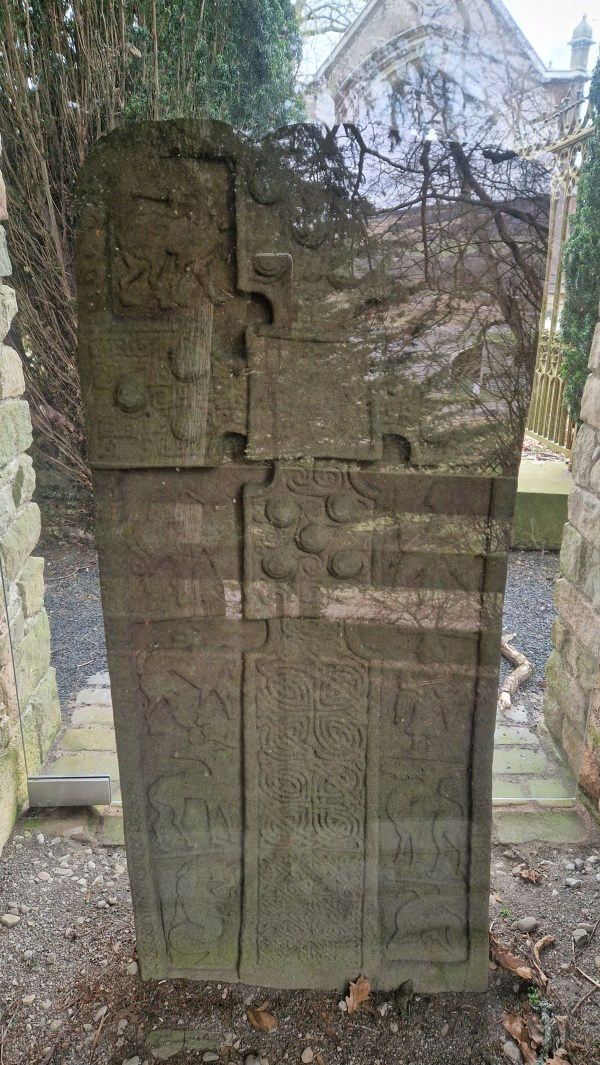
The Dunfallandy Stone is an elaborately carved Class II Pictish stone which is more than 1200 years old. To protect it from the elements, it has been enclosed in a shelter but disappointingly, reflections on the glass make it difficult to see and photograph. Non reflective glass would certainly have been a better option here.

Reminiscent of intricately decorated Pictish jewellery, this cross-slab once marked a place of prayer and is set in its original location, prominently on a mound known to have been topped by a chapel, where it would have been seen by all that passed by. The relief carvings show the sophistication of Pictish culture, mixing influences from across the British Isles and Europe with local traditions and belief. Typically, the body of the Cross is decorated with the familiar intricate Pictish knotwork.
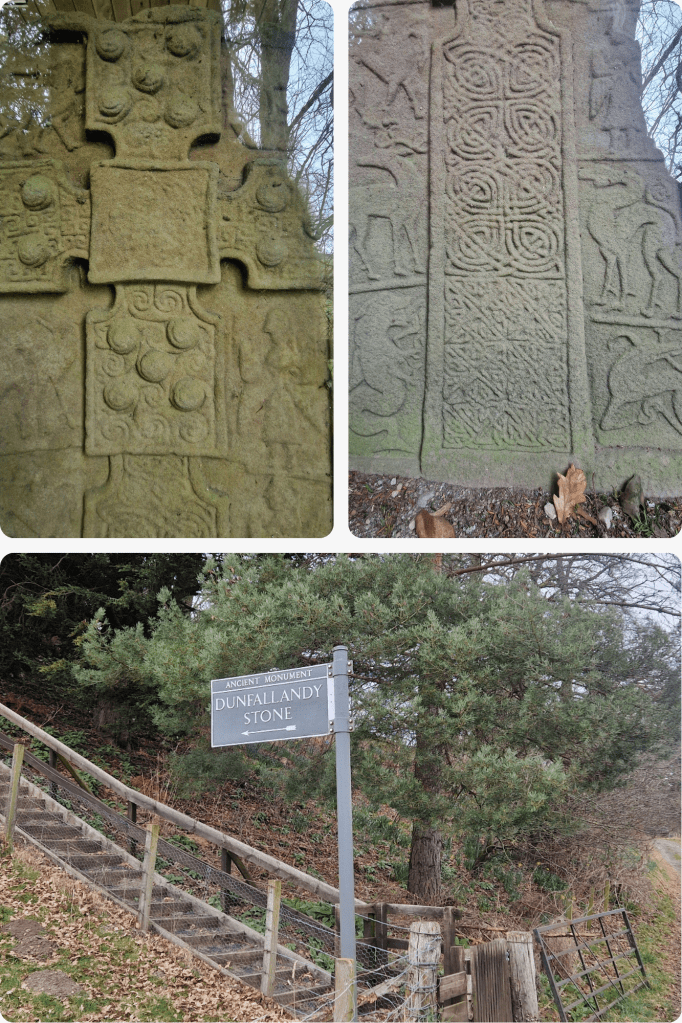
It’s thought that stones such as this one were once coloured, using mineral pigments such as yellow ochre, red lead and green verdigris, emulating the style of metalwork and religious manuscripts of the time. The images on the front depict Pictish monsters (considered agents of God’s wrath), a stag, Jonah being swallowed by a whale and angels. On the reverse side, depictions are of enthroned bishops or saints facing each other, a rider representing perhaps the patron who commissioned the stone then at the bottom are Iron-working tools (tongs, hammer, crucible). There are also several distinctively Pictish symbols on the reverse here, the Pictish monster, double disk and the crescent with v-rod however their true meaning is now lost to us.

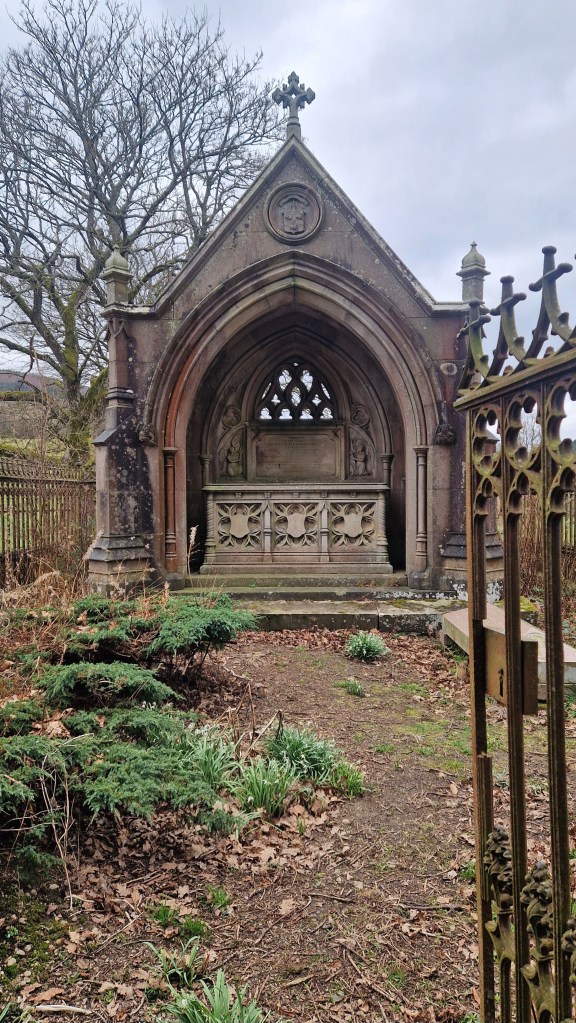
Dunfallandy Stone now shares the mound with burial enclosures surrounded by railings. One of these is the site of the impressive tomb of Lieutenant-General Archibald Fergusson of Dunfallandy who died in 1834. This, I assume would be why the location was referred to as Mausoleum Mound from the 1860’s.
Standing Stones of Lundin, Lundin Links – Fife

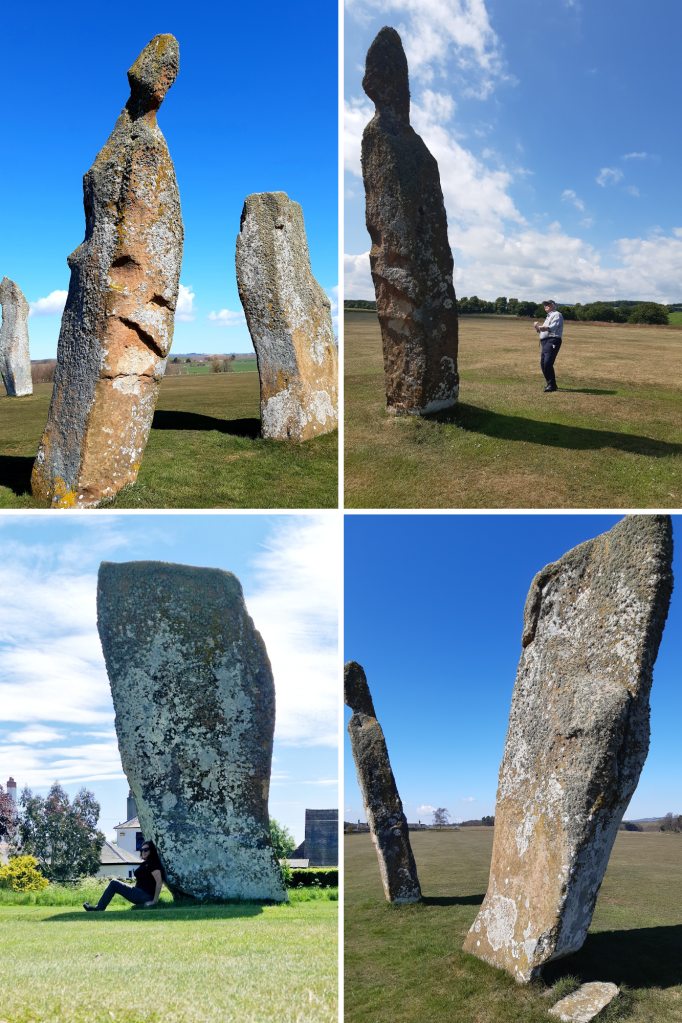
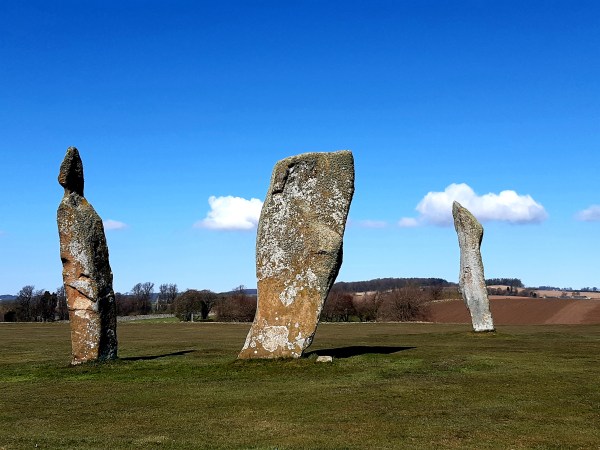
Where once where there were four, now there remains three very impressive, irregularly shaped, red sandstone megaliths. They are thought to have originally been part of the 16M circumference of a complete stone circle from the bronze age, 2000 – 1500BC. It’s said that the missing fourth stone had been broken by treasure hunters, the base remaining with the broken upper lying nearby until 1792. It was then moved by a farmer to allow for better ploughing of the field and was subsequently lost to memory.

A stone lined grave (cist) containing a skull was discovered near the Lundin stones in 1844. The skull, was given to Prof of Anatomy at Edinburgh University, Sir William Turner, who reported it had a metal arrowhead imbedded within a fracture but this crumbled to rust when it was touched. The discovery of the ‘ancient sepulchre’ draws parallels with other standing stone sites in Fife where human remains were also found. 

Local folklore tells that the Lundin stones were memorials to Danish Chiefs who had been slain during a great battle here. However, these days the stones are witness to nothing more belligerent than golfing competitions as they present a magnificent feature on the second fairway of Lundin Links Ladies Golf Course.

The stone sitting south east, has a height of 4.2M with a slight northward incline. This one is heavily weathered, pitted with a large crack that has developed on its east side. The south stone is 4.6M in height and decidedly inclined southward. Lastly, the north stone is the tallest at 5.1M, having a slight incline westward. Bear in mind that in order for these stones to remain standing they will need be seated into the ground to equivalent lengths

I’ve come here many times with family or friends who’ve had an interest in Scotland’s ancient history and they’ve all been impressed with the magnitude of the Lundin Stones and the fact that they still remain after all this time. If you decide to visit, please be polite by asking at the Club House if it’s safe to walk to the stones as there may be golfers about to tee off. Be sure to also skirt the course on your way to and from the site. A blow to the head with a golf ball could mean your skull might be the next to leave here with a fracture!

Guard of Honour

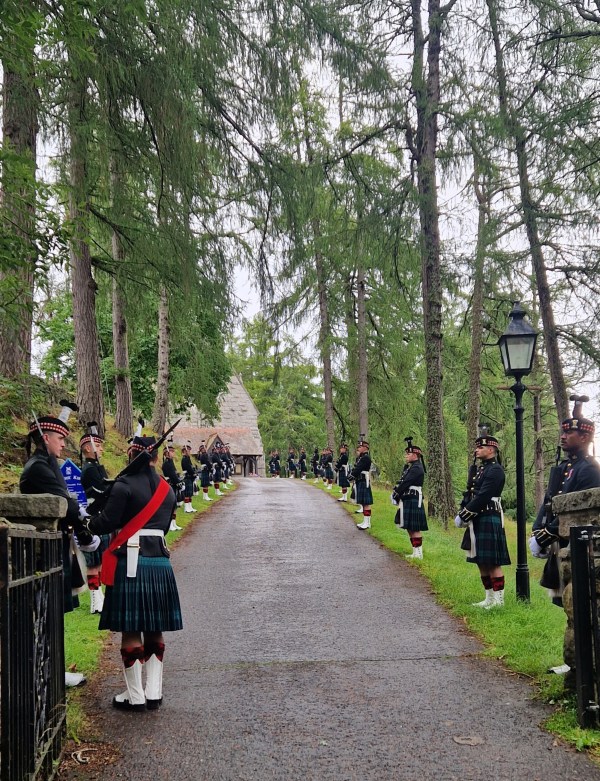
Fortuitously, I was in a café in Ballater when I heard this event would be taking place and as I was only a 15 minute drive away I thought I’d go along to watch the proceedings.

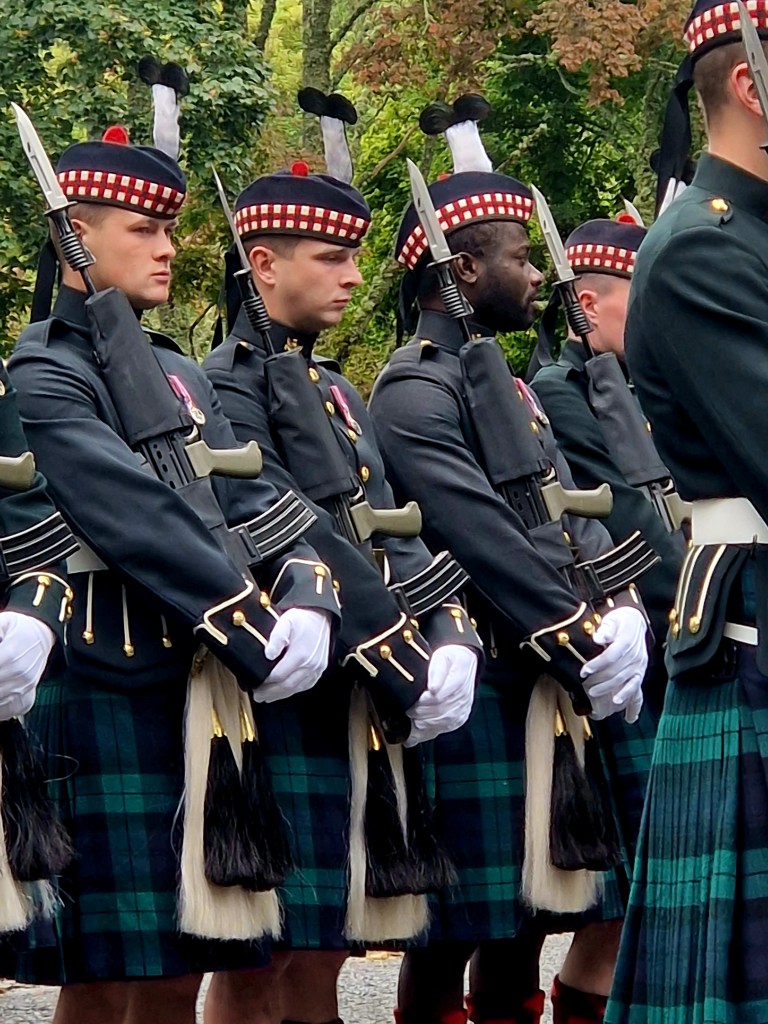
Balaklava Company, 5th Battalion of the Royal Regiment of Scotland, forms a Guard of Honour at Crathie Kirk to welcome members of the Royal Family. The British Royal Family have worshiped here at Crathie for over a century. While they are an independent rifle company, Balaklava Company are renowned for their ceremonial role in Scotland and remain on Royal Guard at Balmoral for the duration of the Monarch’s summer stay there.

Balaklava Company participated in ceremonies to escort the late Queen, Elizabeth II, in her coffin from Balmoral to Edinburgh then onward to London. They were also involved in her funeral. Lieutenant General, Nick Borton, said “It’s a deeply personal attachment for all the soldiers in the regiment to be involved in her funeral arrangements,” he said. “She was very fond of the regiment and all the soldiers in it. For us, it’s not just a military task, we’re saying goodbye to our Commander in Chief and our Colonel.”

Blog at WordPress.com.

Up ↑