The Aberlermno Stones – Forfar

I was excited to come here on this wet and incredibly windy day to encounter a trio of remarkable remnants from our ancient past.  AND what a way to begin my journey into Scotland’s pre-history!  The Picts ruled much of Scotland during the Dark Ages, had a strong and distinct culture yet little is known of these warring and artistic people.  Along the roadside in the village of Aberlermno are three magnificent Pictish stones bearing symbols from three graphic styles as their society evolved from Pagan to Christian worship.

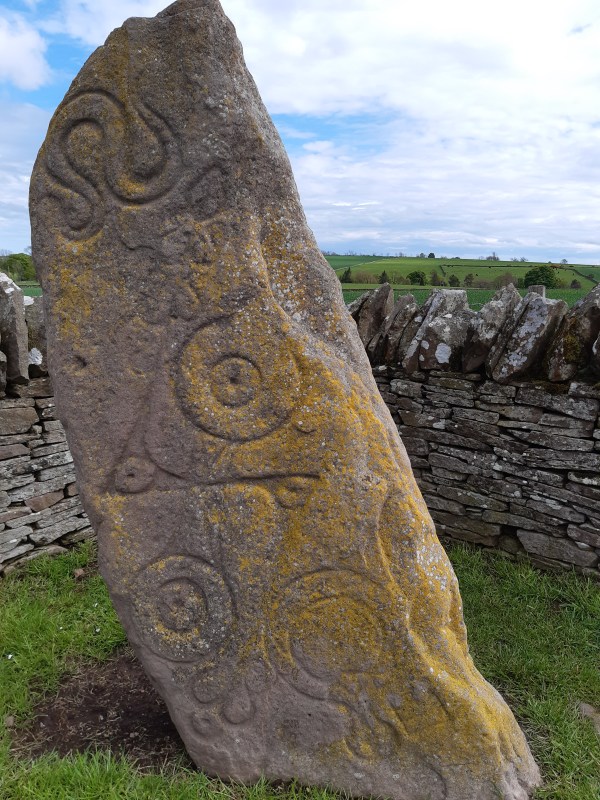
The Serpent Stone – cup marks on the left side of this stone suggest that it was most probably a neolithic standing stone, reused by the Picts. This is a Class I stone, standing nearly 2m tall with carvings deeply incised and still clearly visible.
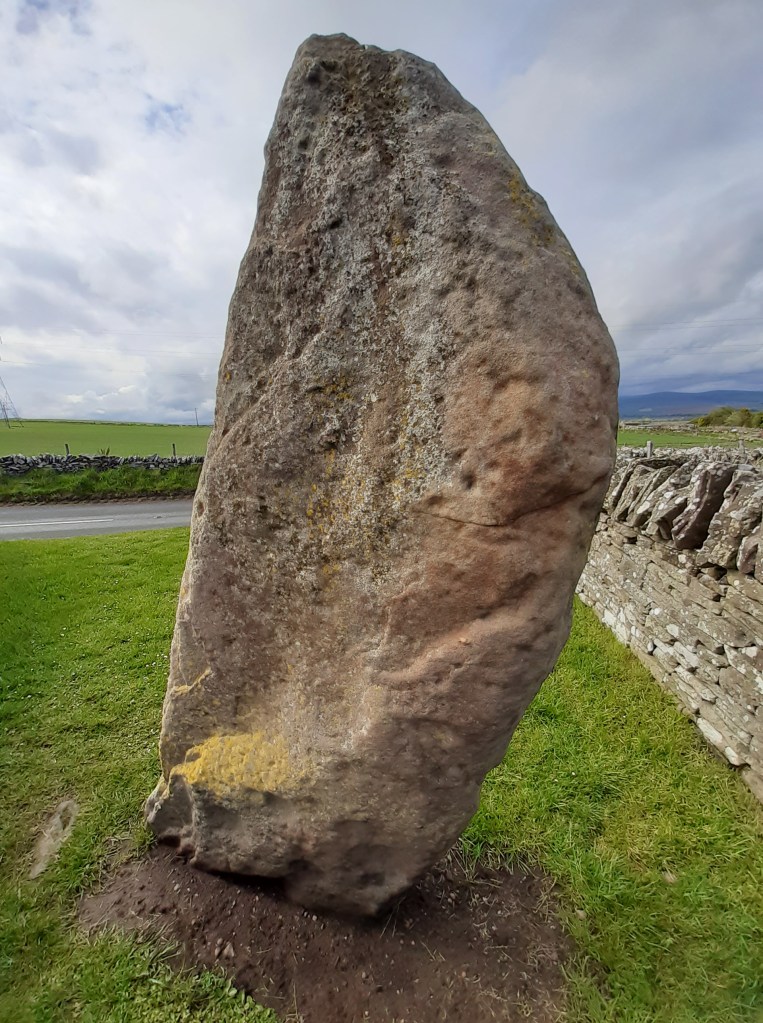
Class I stones – are natural rocks or boulders bearing incised Pictish symbols dating from the early bronze age. They bear no Christian images therefore likely carved before the arrival of St Columba and adoption of Christianity into Pictish culture.

This stone’s markings show a serpent above a double-disc and z-rod then a mirror and comb.

Serpent – throughout the World snakes have been associated with magic, death and rebirth, sex and healing.

Double Disk – perhaps represents two worlds: the here-and-now and the otherworld, life and death.  Its has also been suggested that it signifies the marriage of two families. Z-Rod – this could represent someone whose spear was broken – dead – or who was a breaker of spears – a great warrior

Mirror & Comb – although on some stones the mirror is shown alone it is frequently thought to represent a woman. In the ancient world it has been used elsewhere as a symbol of the mother Goddess.  Mirrors and combs also have magical connotations, appearing in folklore as enchanted objects

Whatever the meaning behind the symbols on this wonderful stone, they had a clear significance for the people who made them.  The incisions are carbon dated at around 1500 years ago, elements of a lost hieroglyphical system used by the Picts for up to four centuries.  They could represent a person of status within their community, mark a tribal location or make known tribal allegiance.
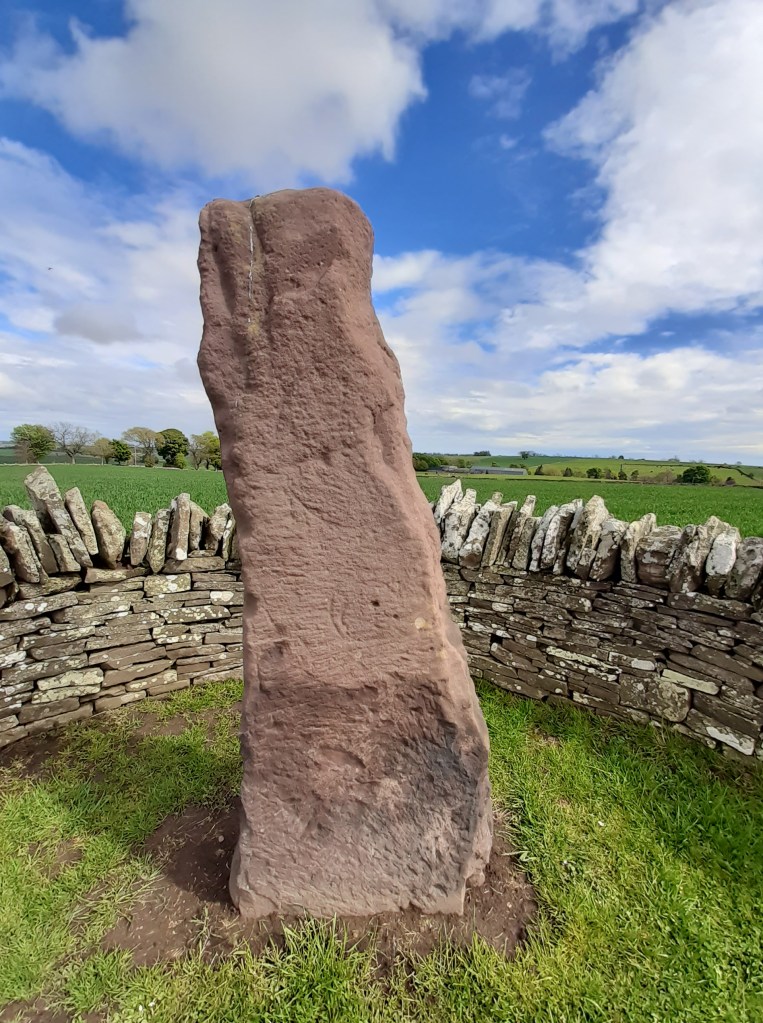
The Crescent Stone – only faint traces of a crescent marking and mirror remain on this Picitsh standing stone but nevertheless it still stands impressively alongside its neighbouring monoliths.   

Crescent – having lunar associations, this could also represent the firmament. Often crossed with a v-rod (broken arrow), it’s one of the most common Pictish symbols.

Over these many centuries, such ancient monuments have eroded so that their stories are now completely lost to the wind and rain.
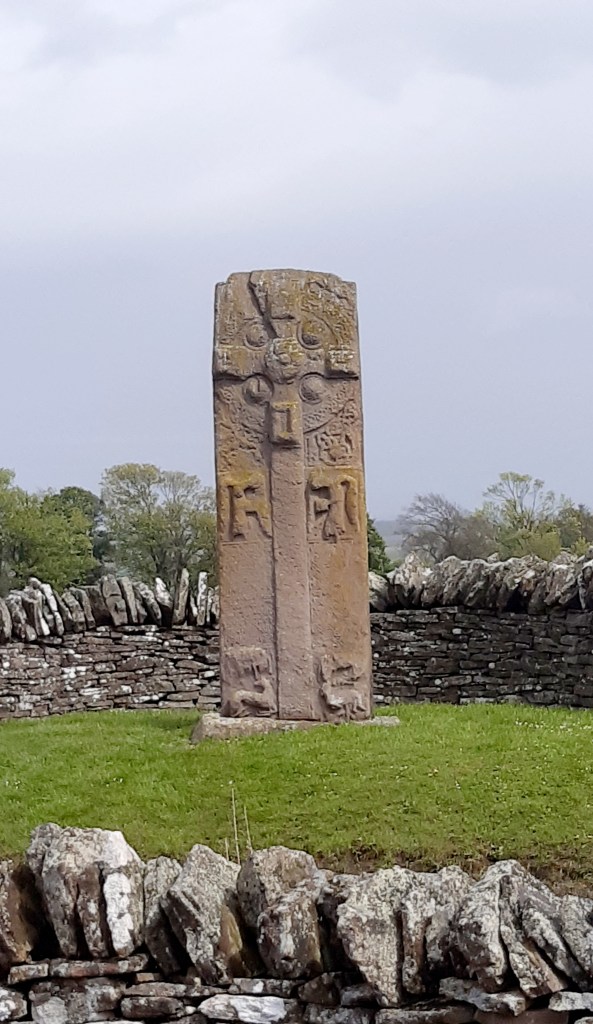
The Roadside Cross – standing in its original socket for over 1200 years, this stone is a Class II stone and testament to flourishing Christianity which had turned the Picts away from their Pagan religion within a mere 200 years of introduction.  This impressive cross-slab was a declaration to the Glory of God. 

Class II stones – these are shaped stones, carved in relief and almost always cross-slabs with Christian imagery and some traditional Pictish symbols.

The front of this stone has been deciphered as follows:  Within a massive wheelhead cross there are Five circular bosses on the cross – possibly representing the wounds of Christ.  Mourning Angels – holding gospel books.

The rear side:  the top displays a Pictish symbol, the V-Rod – possibly the rising and setting of the sun/moon, then, below it there’s a Double Disk and Z-Rod – more elabourate than on the Serpent stone.  A ceremonial hunt – with trumpeters below prominent Pictish symbols. David saving his flock from a lion – perhaps representing Christ the saviour. A centaur gathering medicinal plants – representing Christ the healer                                    

These stones truly are incredible and although sitting by the roadside, each has been situated sympathetically in a small walled area to allow them to be viewed up-close.  Grab your raincoat and go…!
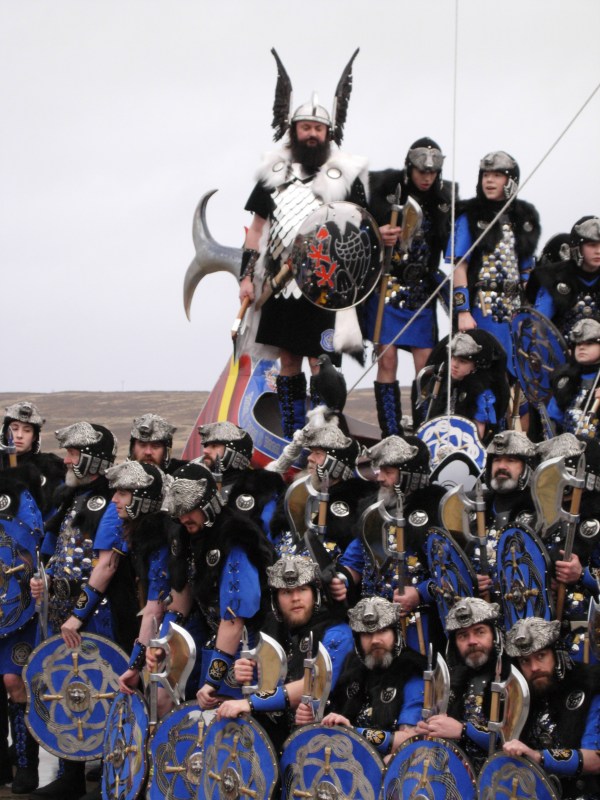
Up Helly Aa, Lerwick – Shetland

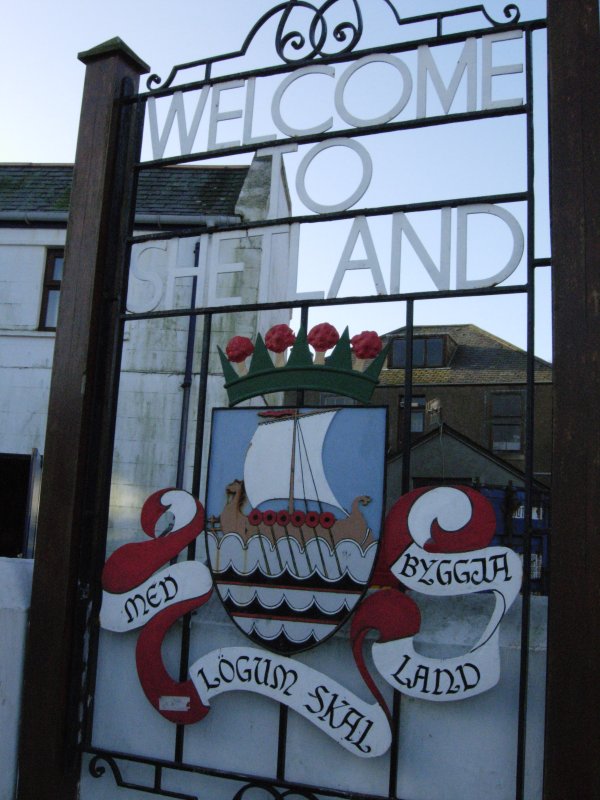
Shetland and Orkney had been domain of the Vikings from around 850 AD. In 1469 however, Princess Margaret, the 13 year old daughter of King Christian I of Denmark & Norway, was betrothed to King James III of Scotland. Her dowry was set at 6000 Guilders yet King Christian could only come up with 2000 Guilders therefore Shetland & Orkney were offered as security for the rest. The outstanding amount was never realised, so, on 20th February 1472 via an act of Parliament, both Orkney and Shetland officially became part of Scotland. Gradually Scottish culture spread throughout the islands but Norse customs and the Old Norse language have remained routed in the identity of the islanders over these many centuries. While Norse words and names are still evident the most discernible characteristic of Viking heritage are the Up Helly Aa events held throughout the Shetland archipelago from January to March every year.

The Up Helly Aa tradition began in the mid 19th century and gradually evolved into the annual festival we witness today, with many aspects still echoing the Viking celebrations of 150 years ago. Islanders are very much involved in the event and need to have been resident in Shetland for at least five years before they can even participate in a squad and the procession. To be Guizer Jarl, a member must have served at least 16 years on the committee.

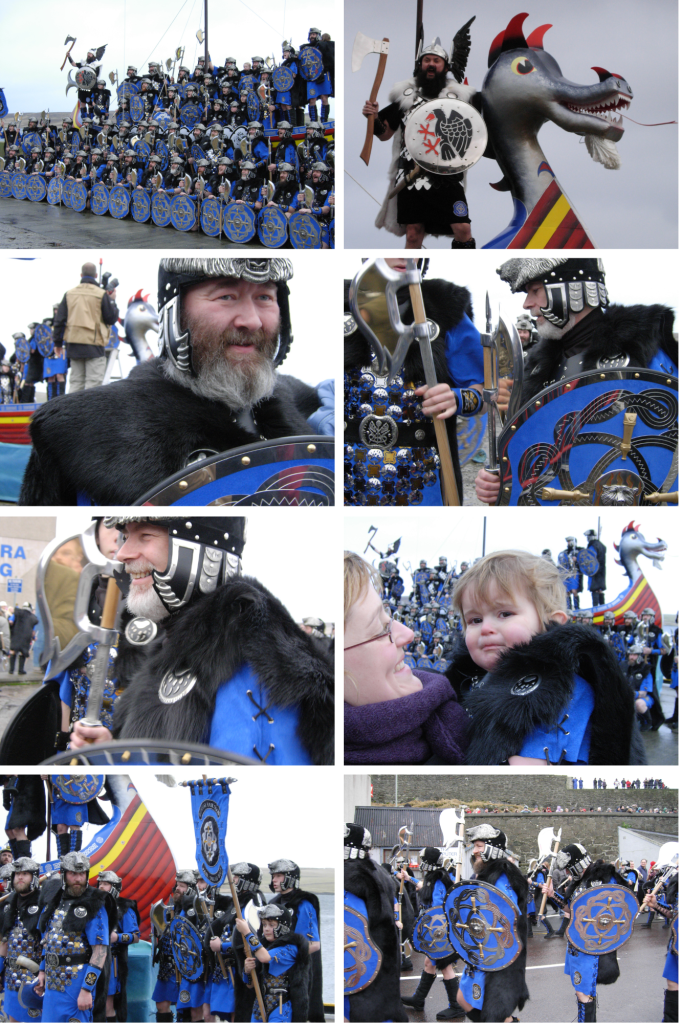
The building of the Viking Galley, making Viking costumes and the thousands of torches are done by volunteers and the Jarl Squad, working tirelessly throughout the winter until everything is ready. The reveal of the Galley and the Jarl Squad is kept a secret until the big day when they step out for the first time to start the Up Helly Aa morning parades.

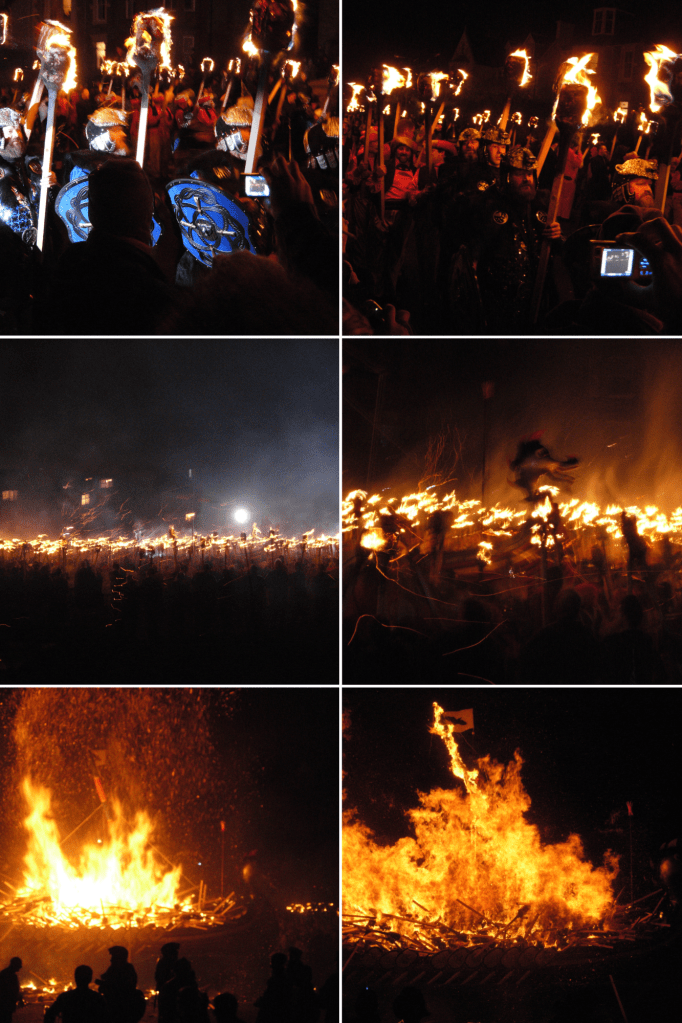
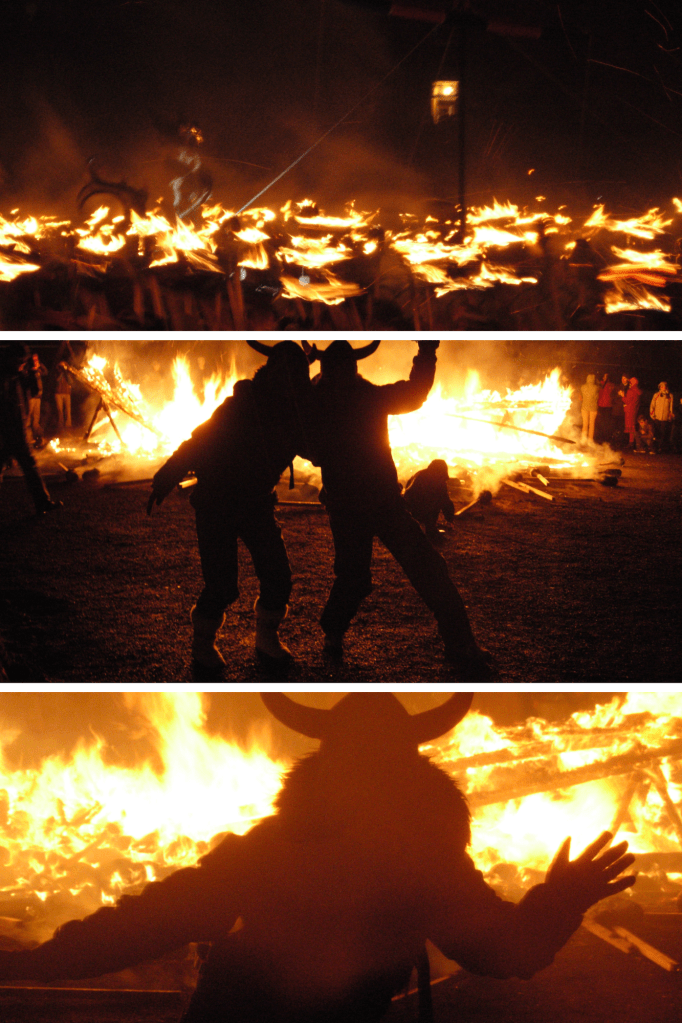
The evening procession incorporates 46 additional squads dressed in a variety of themes with performances choreographed in preparation for the after event parties. When darkness has descended, the squads assemble at 7pm to the sound of a Pipe Band after which the Guizer Jarl and his squad are ushered forward to the head of the parade with their Viking Longboat in tow, accompanied by the local Brass Band. All other squads then follow, marching behind them and through the town until finally reaching the Playing Field, circling the perimeter before heading to the Burning Site where the magnificent replica longboat is torched. This burning of the Galley signifies the end of the Yule period, in legendary Viking style, of course!

The festivities then move to many community halls where locals and visitors party through the night, dancing to Scottish Country Music and lapping up the entertainment provided by the guizer squads.

This celebration of Shetland’s Viking heritage is a festival unlike any other in the World. It truly is a community event with Lerwegians exuding immense pride in their uniquely special day and we found everyone to be incredibly welcoming and friendly. If you have a list of adventures you’d like to fulfil, I can highly recommend Up Helly Aa is on it!

Flying Trip to Lerwick for Up Helly Aa – Shetland

When your long-time buddy is a modern day Viking and you have some Viking blood flowing through your own veins, the best way to blow away the winter blues, of course, is by attending an ancient Viking festival. I’d listened to stories of Up Helly Aa as I was growing up and was excited to finally be going to this legendary event. Anne Lise arrived in Aberdeen from Oslo and we flew together, onward to Lerwick in Shetland, on an outstandingly beautiful day for a bucket list adventure.

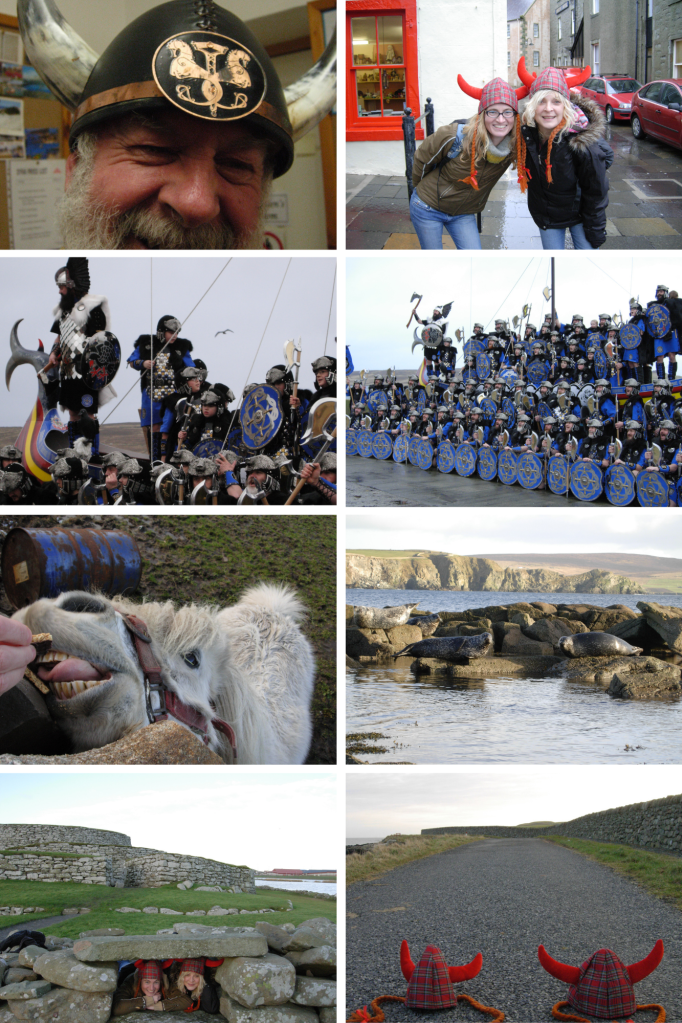
We’d booked into Lerwick hostel and on arrival, were greeted enthusiastically by the Manager, who showed us to our communal accommodation. He was a mine of information, providing us with details of where we needed to be and when, to make the most of our experience. He also, very kindly, insisted on driving us into town where we could find a bite to eat. Within moments of having ordered some food and sitting at our table we were surrounded by curious locals, enquiring who we were, where we were from and inviting us to a week of celebratory Up Helly Aa parties. They probably were fascinated with our mad hats! Next stop, a crowded bar that was full to bursting with good-humoured, Shetlanders, drinking and taking turns in the band that played traditional Shetland music into the early hours. Our trip couldn’t have gotten off to a more enjoyable start. What absolutely lovely folk! Back at the hostel that night, we bunked up along side fellow festival goers, two of whom were somewhat more ‘mature’ ladies. The pair seemed to have boundless energy, had been out walking all day, gone out for dinner, enjoyed the local music scene and were last to bed…and not very quiet about it either.

Up Helly Aa day and by 9.30am we were at Alexander Warf, waiting to see the Guizer Jarl and his Squad march into position for an iconic photo opportunity with their hard-wrought, beautifully crafted galley. And what a handsome band of Vikings they were. The mood was jovial and everyone was filled with elation for the day ahead. When eventually the Squad marched off to attend their community events, Anne Lise and I wandered along the Esplanade to the Market Cross then into town to browse around Lerwick’s old, narrow streets and quaint little shops. With plenty of time to spare, we also decided on exploration of the shore area, seal watching and making a fuss over loveable Shetland ponies, all the way out to Clickmin Broch (a bronze age settlement dating back to circa 400BC). The weather was wild and windy, exhilarating as we walked, filling us with anticipation for the upcoming festival to celebrate the end of Yuletide in this Viking world.

Darkness fell, the wind howled and the rain lashed but regardless, by 7pm the streets surrounding King Harald Playpark were lined with throngs of locals and visitors alike, waiting in suspense for the torchlit procession to begin. A strong smell of paraffin from hundreds of flaming torches filled the air as Guizers from 46 other squads mustered into place. The Jarl Squad was ushered through the ranks, towing the Galley with the Guizer Jarl standing magnificently at the prow while a brass band blared renditions of the ‘Up Helly Aa Song’, the ‘Galley Song’ and ‘The Norseman’s Home’. The spectacle of hundreds of Guizers with their flaring torches parading the around the streets, all singing proudly, was an unforgettable sight. Eventually, the Galley was lead into the Playground to its final repose, the Guizers spiralled around until an ultimate rendition of ‘The Norseman’s Home’, when Guizer Jarl stepped down at the very last moment and was first to hurl his torch into the longboat. With complex manoeuvring, hundreds of torches arched their way into the Galley, both an achingly sad yet breath-taking moment in this fiery comital and dispatch to Valhall. The heat was intense no matter where we were standing, everyone waiting with baited breath for the mast and then the dragon figure-head to collapse into the inferno.

With the ceremony at an end, the crowds gradually dispersed to ready themselves for whichever of the Up Helly Aa parties they were attending while the members of each squad made final preparations for their performances for the evenings attendees. Anne Lise and I had pre-arranged tickets for a ceilidh at the community centre so were thrilled to spend the rest of this incredible day being entertained by the squads and asked to dance by affable Shetlanders, into the wee small hours….

Dogton Stone, Cluny – Fife

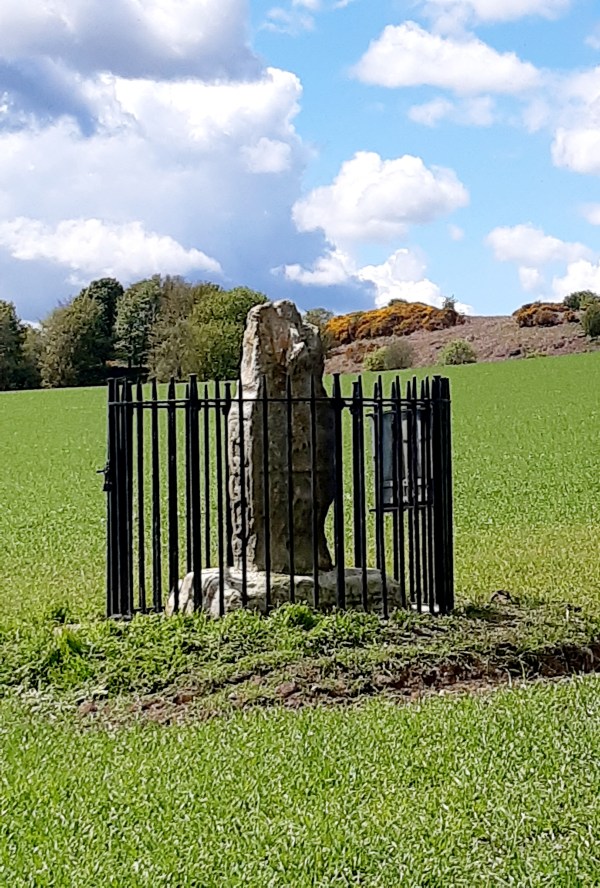
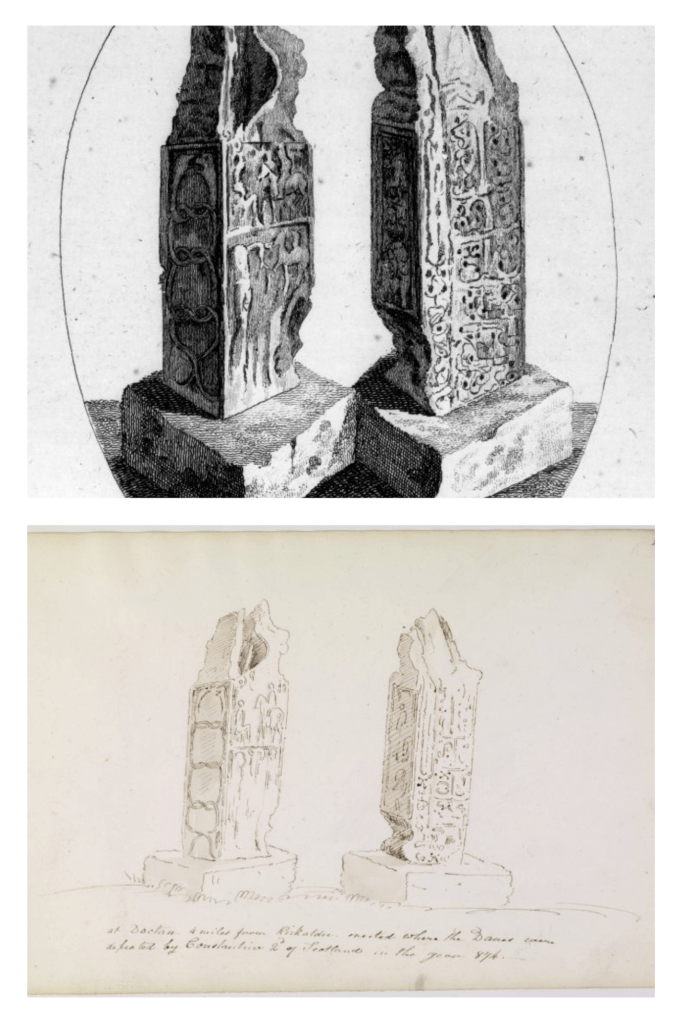
In a wheat field at Dogton Farm, there stands a long forgotten Pictish Stone. Enclosed in iron fencing for protection, it’s a 9th century Class III, free-standing Pictish Cross which seems to have lost its head and arms centuries ago. An etching of the stone was done in 1772 by Thomas Pennant (1726-1798, Welsh naturalist, traveller, writer & antiquarian). Then, another sketch from 1832 by James Skene (1775-1864, Scottish lawyer and amateur artist, best known as a close friend of Sir Walter Scott), mentions that the stone was “at Dogton, 4 miles from Kirkcaldy, erected where the Danes were defeated by Constantine 2 of Scotland in the year 874”. Both illustrate the Dogton stone in its damaged condition.

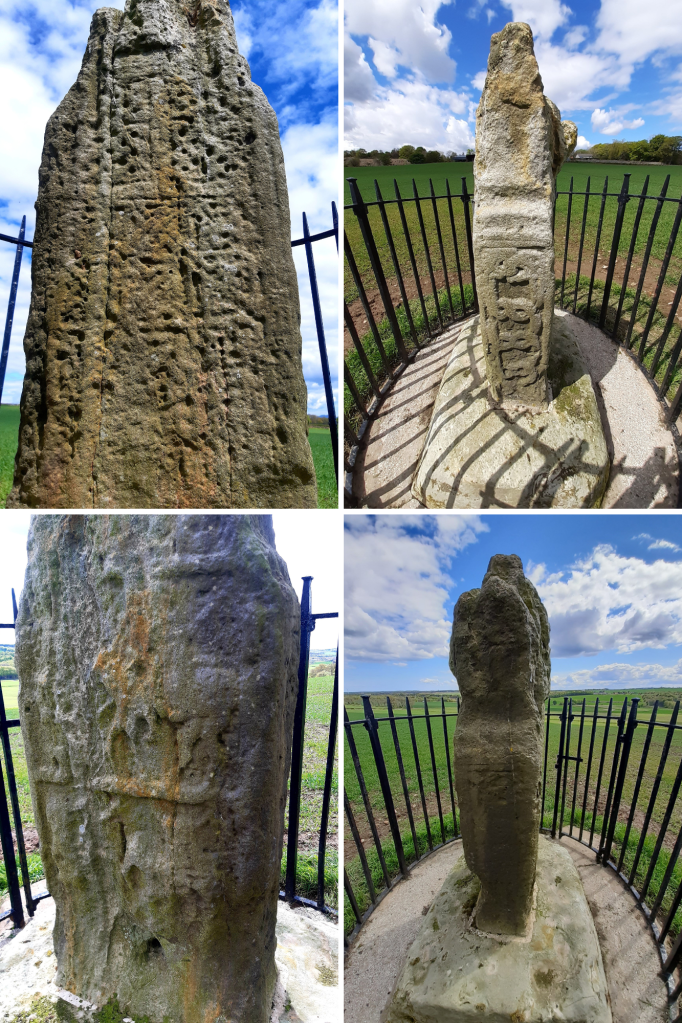
The stone stands around 4ft 10ins (1.5M) and had originally been sculpted in relief on all four sides, however, the weather over these many centuries has taken its toll. On the West facing side, intricate knotwork, typical of Celtic artistry can still be clearly seen. Stretching up the South side of the stone, two entwined, snapping serpents are depicted. It’s said that in Celtic culture, serpents were sacred to high-ranking members of society, associated with rebirth, eternal life and healing. The East face shows what once was a battle scene, with a horseman still quite visible. Unfortunately the North face of the Dogton stone is so very weathered, it’s not longer discernible.

What an incredible sense of awe I felt, to have come across such a remarkable piece of ancient history and it set my mind rambling with thoughts of the people who created this and why it would have been erected here. It’s possible the stone could have been erected to specifically mark the victory in battle of Constantine 2nd over the Danes, or, perhaps, simply as a decorative way marker for pilgrims heading towards religious sites such as nearby Scotlandwell, Lindores Abbey, Balmerino Abbey, or St Andrews where holy relics of Saint Andrew were displayed in the Cathedral there. Oh to be a time traveller….

NB: Class III Pictish Stones – these originate from the 8th or 9th century and feature none of the unique Pitctish symbols of earlier stones, typically free-standing crosses which include Christian imagery.

Blog at WordPress.com.

Up ↑